The Nordic region unfolds like a grand, living tapestry-a sweep of rugged coastlines, ethereal archipelagos, and cities that hum with quiet design. Yet, the dream of a multi-country Nordic journey often meets the reality of intricate logistics. The question of how to travel between Nordic countries, navigating from mainland capitals to pristine, far-flung islands, can feel as vast and complex as the landscapes themselves. The uncertainty of whether to choose a scenic train, a serene ferry, or a swift flight can stall even the most inspired plans.
Consider this your definitive map and compass. In this curated 2026 guide, we unravel the complexities, transforming logistical challenges into seamless, elegant transitions. We will illuminate the most efficient and breathtaking routes, empowering you to design a bespoke itinerary that flows as gracefully as the fjords. Prepare to move beyond the planning stage and step into your own Nordic odyssey with absolute clarity and confidence.
Key Takeaways
- Master Nordic logistics with our strategic framework, breaking the region into three distinct travel zones: the Mainland Spine, Baltic Bridge, and Atlantic Leap.
- Discover when to choose the scenic efficiency of high-speed trains versus the magic of an overnight Baltic Sea ferry cruise between nations.
- Identify the key Scandinavian airport hubs that serve as the essential gateways for reaching the remote beauty of Iceland, Greenland, and the Faroe Islands.
- Learn how to travel between Nordic countries seamlessly by weaving these transport modes into a single, perfectly curated journey with our sample itineraries.
The Nordic Travel Puzzle: Planes, Trains, Ferries & Cars
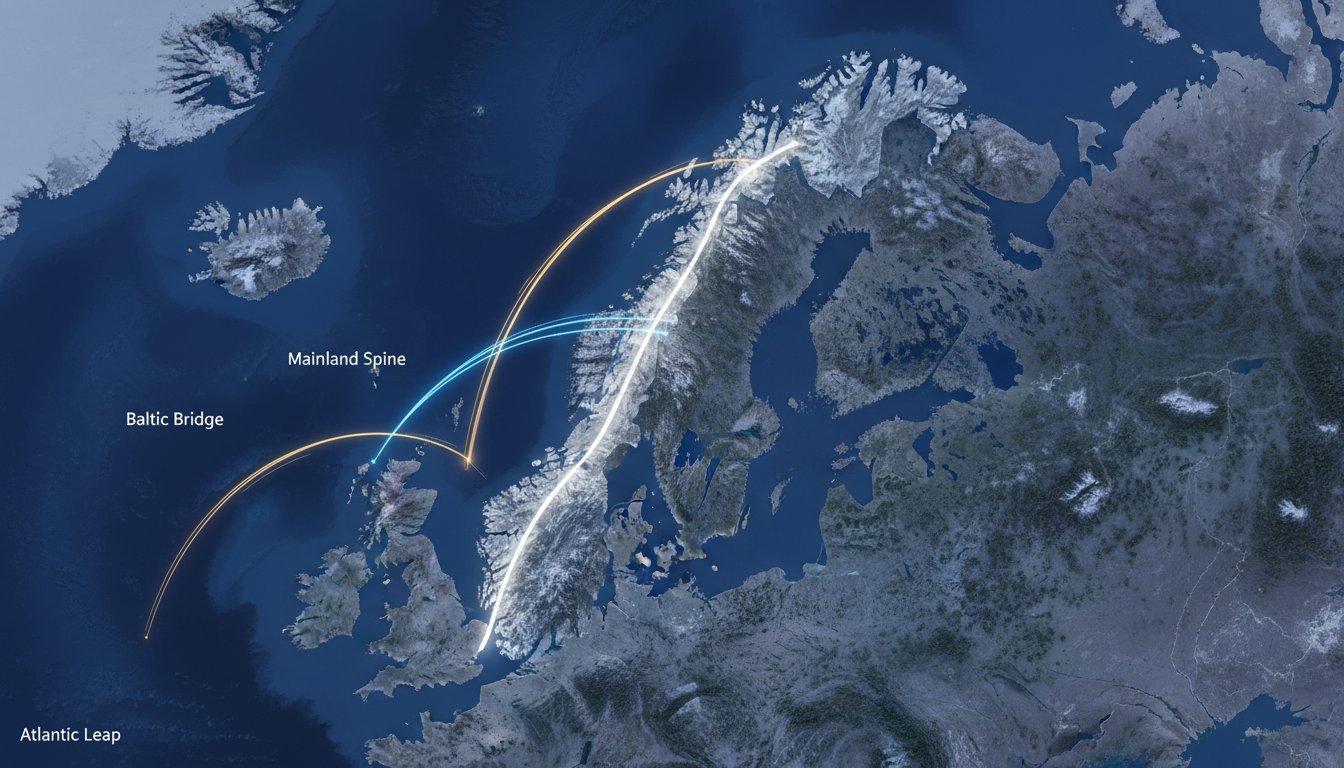
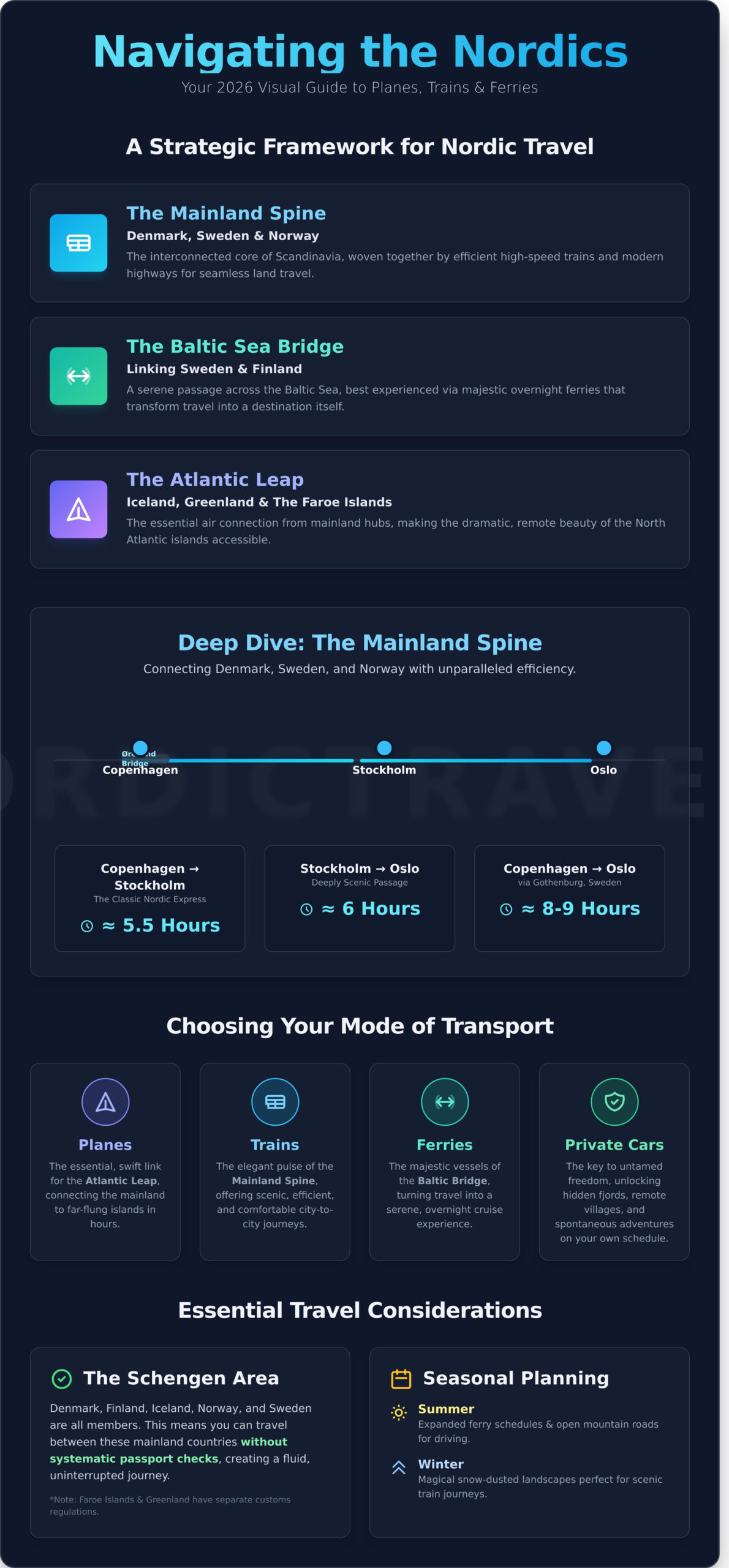
To truly understand how to travel between Nordic countries, one must first grasp the region’s magnificent geography. The Nordics encompass the sovereign states of Denmark, Finland, Iceland, Norway, and Sweden, along with their autonomous territories. It’s a vast and varied canvas. To navigate it seamlessly, we view the journey through a curated framework: the interconnected Mainland Spine (Denmark, Norway, Sweden), the serene Baltic Bridge (linking Sweden and Finland), and the dramatic Atlantic Leap (to Iceland, Greenland, and the Faroe Islands).
Each mode of transport plays a bespoke role in this grand design:
- Planes are the essential link for the Atlantic Leap, connecting the mainland to ethereal, far-flung islands in mere hours.
- Trains are the elegant pulse of the Mainland Spine, gliding through pristine forests and along rugged coastlines. The efficiency of the network is a testament to the highly developed transport infrastructure in Sweden, which forms the core of this land-based travel.
- Ferries serve as the majestic vessels of the Baltic Bridge, transforming the passage between capitals like Stockholm and Helsinki into a serene overnight voyage.
- Private Cars offer the key to untamed freedom, unlocking hidden fjords and remote villages entirely on your own schedule.
The most profound Nordic experiences are born from weaving these methods together, creating a tailor-made journey that is as breathtaking as the destinations themselves.
Understanding the Schengen Area
Your journey across the Nordic mainland is defined by effortless movement. Denmark, Finland, Iceland, Norway, and Sweden are all members of the Schengen Area, which eliminates systematic internal border controls. This means you can travel between Copenhagen, Oslo, and Stockholm by train or car without routine passport checks, creating a truly fluid and uninterrupted experience. Do note, however, that the remote and beautiful Faroe Islands and Greenland, while part of the Kingdom of Denmark, have separate customs regulations.
A Word on Seasons and Transport
The Nordic rhythm is dictated by its distinct seasons, and your transport choices should reflect this. Summer’s endless light brings expanded ferry schedules across the Baltic and opens spectacular mountain roads for driving. Conversely, winter casts a magical spell, making a scenic train journey through a snow-dusted landscape an unforgettable highlight. To ensure your adventure remains seamless, we always recommend booking flights and long-distance trains well in advance, particularly during peak summer and winter holiday periods.
The Mainland Spine: Seamless Travel in Denmark, Sweden & Norway
The Scandinavian kingdoms of Denmark, Sweden, and Norway are woven together by a sophisticated tapestry of steel rails and smooth asphalt, offering a truly seamless travel experience. This mainland spine allows for an effortless flow between vibrant urban hubs and pristine, rugged landscapes. At its heart lies the iconic Øresund Bridge, an architectural marvel that soars over the water, transforming the journey from Copenhagen to Malmö from a sea crossing into a breathtaking 30-minute glide-a powerful symbol of the region’s interconnected spirit.
For discerning travellers, high-speed trains are the quintessential mode of transport. They slice through the countryside with quiet efficiency, offering a front-row seat to the ethereal beauty of passing forests and mirror-like lakes. The network’s popularity and extensive reach, as reflected in official EU rail statistics, underscore its role as the premier method for city-to-city journeys. It’s an experience curated for comfort and immersion, allowing you to simply relax as the Nordic panorama unfolds.
Key Train Routes & Journey Times
These core routes form the backbone of any Scandinavian itinerary, connecting the capital cities with remarkable ease:
- Copenhagen to Stockholm: The classic Nordic express. This direct, high-speed journey takes approximately 5.5 hours, whisking you from Danish design to Swedish sophistication.
- Stockholm to Oslo: A deeply scenic passage of around 6 hours that winds through a pristine landscape of dense forests and shimmering lakes, offering a true taste of the wild.
- Copenhagen to Oslo: This route typically involves a swift and easy change in Gothenburg, Sweden, with a total travel time of about 8-9 hours.
Train vs. Bus: A Quick Comparison
While trains offer unparalleled speed and comfort, luxury coach services present a compelling, budget-conscious alternative. Coaches provide a reliable and often significantly cheaper option, though at the cost of longer journey times. The trade-off is simple: choose trains for swift, scenic comfort; opt for buses for maximum value. When deciding how to travel between Nordic countries, consider what you prize most: time or budget. Key national train operators to know are SJ (Sweden), DSB (Denmark), and Vy (Norway).
Is an Interrail/Eurail Pass Worth It?
The allure of a Eurail or Interrail Pass is its promise of freedom. For a grand, multi-stop Scandinavian tour with a flexible itinerary, it can be excellent value. However, for a trip with only a few pre-planned stops, purchasing point-to-point tickets in advance is almost always more economical. It’s crucial to remember that on most high-speed and long-distance services, a seat reservation is mandatory and comes at an additional cost, slightly diminishing the pass’s all-inclusive appeal.
The Baltic Sea Bridge: Scenic Ferries from Sweden to Finland
Forget fleeting flights and hurried trains. When considering how to travel between Nordic countries, the most magical passage is to surrender to the gentle rhythm of the Baltic Sea. The overnight journey from Stockholm to Helsinki is less a transfer and more a curated experience-a mini-cruise that transforms travel into an essential part of your Nordic tale. As you dine, dance, and dream, you glide towards your destination, cleverly saving on a night’s accommodation and a precious day of exploration. The journey itself is a seamless transition between two captivating cultures, made effortless as both nations are within the Schengen Area, which allows for travel without internal border checks. But the true spectacle is the ethereal passage through thousands of pristine islands in the Stockholm and Turku archipelagos-a silent, cinematic experience that unfolds at dawn.
Major Ferry Routes & Operators
This vital sea link is serviced by world-class operators, offering routes tailored to different itineraries. Each crossing presents a unique perspective on the Baltic landscape.
- Stockholm to Helsinki: The premier overnight route, operated by industry leaders like Viking Line and Tallink Silja. It’s the classic choice for a full-service, cruise-like experience.
- Stockholm to Turku: A slightly shorter and often more economical journey, landing you in Finland’s historic former capital. From Turku, Helsinki is just a comfortable two-hour train ride away.
- Umeå to Vaasa: The fastest crossing, bridging the narrowest point of the Gulf of Bothnia via the Kvarken Archipelago. This route is ideal for travelers exploring the untamed beauty of Northern Sweden and Finland.
What to Expect Onboard
These modern vessels are floating destinations. Step aboard and discover a world of comfort and entertainment designed to elevate your journey. Your private sanctuary for the night can range from cozy, budget-friendly interior cabins to deluxe suites offering panoramic views and exclusive amenities. Beyond your cabin, you’ll find a host of facilities: tax-free shopping boutiques, diverse restaurants serving everything from lavish Scandinavian buffets to refined à la carte dining, serene spas, and even lively nightclubs. For an unforgettable memory, we highly recommend booking a cabin with a sea view to witness the archipelago glide by in the soft morning light.
The Atlantic Leap: Flying to Iceland, Greenland & The Faroes
While the Scandinavian mainland is beautifully connected by road and rail, the wild, ethereal islands of the North Atlantic demand a different approach. For those planning how to travel between Nordic countries and these remote outposts, air travel is not just an option; it is the only practical gateway to the pristine landscapes of Iceland, Greenland, and the Faroe Islands. Major Nordic capitals-primarily Copenhagen, but also Oslo and Stockholm-serve as the essential hubs for these breathtaking journeys.
A crucial point for travellers: contrary to a common misconception, there are no passenger ferries connecting mainland Europe or Scandinavia to Iceland. The untamed beauty of these islands must be reached from the sky. We strongly advise booking these flights well in advance, particularly for the luminous summer months when demand soars.
Reaching Iceland: The Land of Fire and Ice
Your Icelandic saga begins at Keflavík International Airport (KEF), a modern hub set amidst rugged lava fields. Seamless connections are available with direct flights from all major Nordic capitals. Flagship carriers like Icelandair and SAS (Scandinavian Airlines) offer regular, reliable services, making it simple to weave the land of glaciers and volcanoes into your wider Nordic itinerary.
The Path to Greenland & the Faroe Islands
For the truly intrepid, Copenhagen (CPH) is the primary launchpad. It is the main gateway for nearly all international flights to Greenland’s vast, icy wilderness, landing in Kangerlussuaq (SFJ). Similarly, the dramatic, emerald-green cliffs of the Faroe Islands are reached via flights from Copenhagen to Vágar (FAE). These exclusive routes are expertly serviced by specialist airlines such as Air Greenland and Atlantic Airways, ensuring your passage to these untouched corners of the world is as smooth as it is spectacular.
Smart Connections: Mainland Nordic Flights
To position yourself for these Atlantic leaps, or for covering vast distances on the mainland itself, budget-friendly airlines offer excellent value. Carriers like Norwegian and Finnair provide competitive fares on key domestic and intra-Nordic routes, such as the journey from southern Norway up to the Arctic Circle. Mastering these connections is a key part of understanding how to travel between Nordic countries efficiently.
Feeling overwhelmed by the logistics of crafting the perfect island-hopping journey? Let our experts craft a bespoke Nordic itinerary for you. We handle the details, so you can focus on the discovery.
Curated Itineraries: Weaving Your Perfect Nordic Journey
The true art of Nordic travel lies not just in the destinations, but in the elegant threads that connect them. We’ve curated these journeys to transform simple logistics into unforgettable chapters of your story. Understanding how to travel between Nordic countries is the key that unlocks a world of seamless transitions, where a scenic train ride or an overnight sea voyage becomes a cherished memory in itself.
The Scandinavian Capitals: A Symphony of Design (10 Days)
Experience the vibrant pulse of Nordic urban life. This itinerary weaves together three distinct capitals, each with its own unique charm, from Copenhagen’s royal canals to Stockholm’s island archipelago and Helsinki’s avant-garde design districts.
- Days 1-3: Copenhagen, Denmark. Arrive and immerse yourself in Danish hygge and world-class culinary scenes.
- Day 4: The Øresund Crossing. Journey by high-speed train across the magnificent Øresund Bridge to Stockholm, an engineering marvel connecting two nations.
- Days 5-7: Stockholm, Sweden. Explore the historic Gamla Stan before boarding a luxurious overnight ferry across the Baltic Sea.
- Days 8-10: Helsinki, Finland. Awaken to the Finnish coastline and discover a city where bold architecture and serene nature coexist.
Fjords & Northern Lights: An Arctic Dream (14 Days)
Venture from the cultural heart of Norway to the untamed, ethereal beauty of the Arctic Circle. This journey is a study in contrasts, showcasing pristine fjords carved by ice and the celestial dance of the Aurora Borealis.
- Days 1-3: Oslo, Norway. Begin in the capital before embarking on the iconic Bergensbanen (The Bergen Line), one of the world’s most scenic train routes.
- Days 4-6: Bergen & The Fjords. Explore the UNESCO-listed Bryggen wharf and consider a coastal voyage on the legendary Hurtigruten to witness the rugged coastline from the sea.
- Days 7-14: The Arctic North. A short, direct flight transports you to Tromsø, the gateway to the Arctic, for a week of chasing the Northern Lights from your handpicked glass igloo or private lodge.
The Ultimate Nordic Adventure: A Saga of Fire and Ice (3 Weeks)
For the traveller who seeks it all, this grand tour combines continental Scandinavia’s highlights with Iceland’s otherworldly landscapes. It demonstrates the ultimate freedom in how to travel between Nordic countries, including the dramatic leap across the Atlantic. This bespoke journey could begin in Copenhagen, flow through Norway’s fjords, and then, with a seamless flight from a major hub, transport you to the land of glaciers, volcanoes, and geysers in Reykjavík for an unforgettable final chapter.
These itineraries are but a whisper of the possibilities. Your perfect Nordic journey awaits, ready to be crafted. Allow us to tailor your exclusive adventure.
From Nordic Dreams to Seamless Reality
The Nordic region, a vast and varied tapestry, is connected by more than just geography. As you’ve discovered, your journey can unfold aboard sleek Scandinavian trains, across the serene Baltic on a scenic ferry, or by soaring over the Atlantic to the ethereal landscapes of Iceland and the Faroes. Each transition is not merely travel; it is an integral part of the experience, a story in motion.
Understanding how to travel between nordic countries is the first step, but the true art lies in creating a journey that flows with effortless grace. It’s about transforming logistical puzzles into a seamless narrative, allowing you to immerse yourself fully in the pristine beauty and quiet wonder of the North, free from the complexities of planning.
With our deep local knowledge of Nordic logistics, we design expert-curated itineraries that are both ambitious and flawlessly executed. Let us handle the details, so you can embrace the meaningful moments that matter. Start planning your handpicked Nordic journey with us. Your extraordinary northern saga awaits.
Frequently Asked Questions About Nordic Travel
What is the cheapest way to travel between Nordic countries?
For the most economical journey, long-distance buses are an excellent choice, connecting major cities with remarkable efficiency. This mode of transport allows you to witness the pristine landscapes unfold at a gentle pace. While flights offer speed, considering buses is a wise approach for how to travel between Nordic countries on a mindful budget, without sacrificing the scenic beauty of the region. It’s a journey woven into the very fabric of the land.
Is there a train that connects all the Nordic countries?
While a single train does not link every Nordic nation due to the geography of Iceland and the Faroe Islands, an exceptional rail network weaves through the heart of mainland Scandinavia. High-speed and scenic trains provide seamless connections between Denmark, Sweden, and Norway. These journeys are an experience in themselves, offering breathtaking views of rugged mountains, serene forests, and tranquil coastlines from the comfort of your carriage.
Can you drive between Sweden, Norway, and Finland?
Absolutely. A self-drive journey offers the ultimate freedom to explore the untamed beauty of the Scandinavian peninsula at your own pace. The road networks are impeccably maintained, and border crossings are seamless, allowing you to move effortlessly between countries. This bespoke approach lets you discover hidden gems, from ethereal fjord-side villages in Norway to the vast, silent forests of Finnish Lapland, crafting a truly personal adventure.
How long does the ferry from Sweden to Finland take?
The journey is a delightful part of the adventure. The classic overnight ferry from Stockholm to Helsinki is a mini-cruise lasting approximately 16-17 hours, allowing you to dine, relax, and wake up to a new city. For a quicker passage, the route from Stockholm to Turku takes around 11 hours. These voyages glide through stunning archipelagos, offering an unforgettable perspective of the Baltic Sea’s tranquil beauty.
Do I need a passport to travel between Nordic countries in the Schengen Area?
While you will not encounter formal border checks thanks to the Nordic Passport Union, you are required to carry a valid government-issued photo ID at all times. For non-Nordic citizens, this means your passport. For Nordic citizens, a national ID card is often sufficient. This ensures your travel remains seamless, allowing for spontaneous checks by authorities and providing necessary identification for flights, hotels, and other services.
What is the best month to travel through the Nordics?
The “best” time is a matter of the magic you seek. For the ethereal glow of the Midnight Sun and lush, green landscapes perfect for hiking, visit between June and August. For a chance to witness the celestial dance of the Aurora Borealis, embrace the crisp air, and enjoy snow-dusted scenery, the months from December to March offer a truly enchanting winter wonderland. Each season curates its own unique and unforgettable Nordic story.
Is it better to book Nordic travel in advance or be spontaneous?
To ensure a truly seamless and handpicked experience, we recommend booking key elements in advance, especially during peak seasons. Securing your place on iconic train journeys, in exclusive boutique hotels, or on sought-after excursions is crucial for a well-curated itinerary. While the Nordic spirit embraces spontaneity for discovering hidden paths, thoughtful planning is the foundation of a relaxed and deeply personal journey, free from logistical concerns.
Can I take a ferry from Scotland or Denmark to Iceland?
There is no direct ferry service from Scotland to Iceland. However, an epic North Atlantic voyage is possible from Hirtshals in northern Denmark. The Smyril Line ferry sails year-round to Seyðisfjörður in Iceland, with a captivating stop in the Faroe Islands. This journey is an adventure in itself, a passage across rugged seas that connects you to the wild, untamed heart of these remote and beautiful island nations.