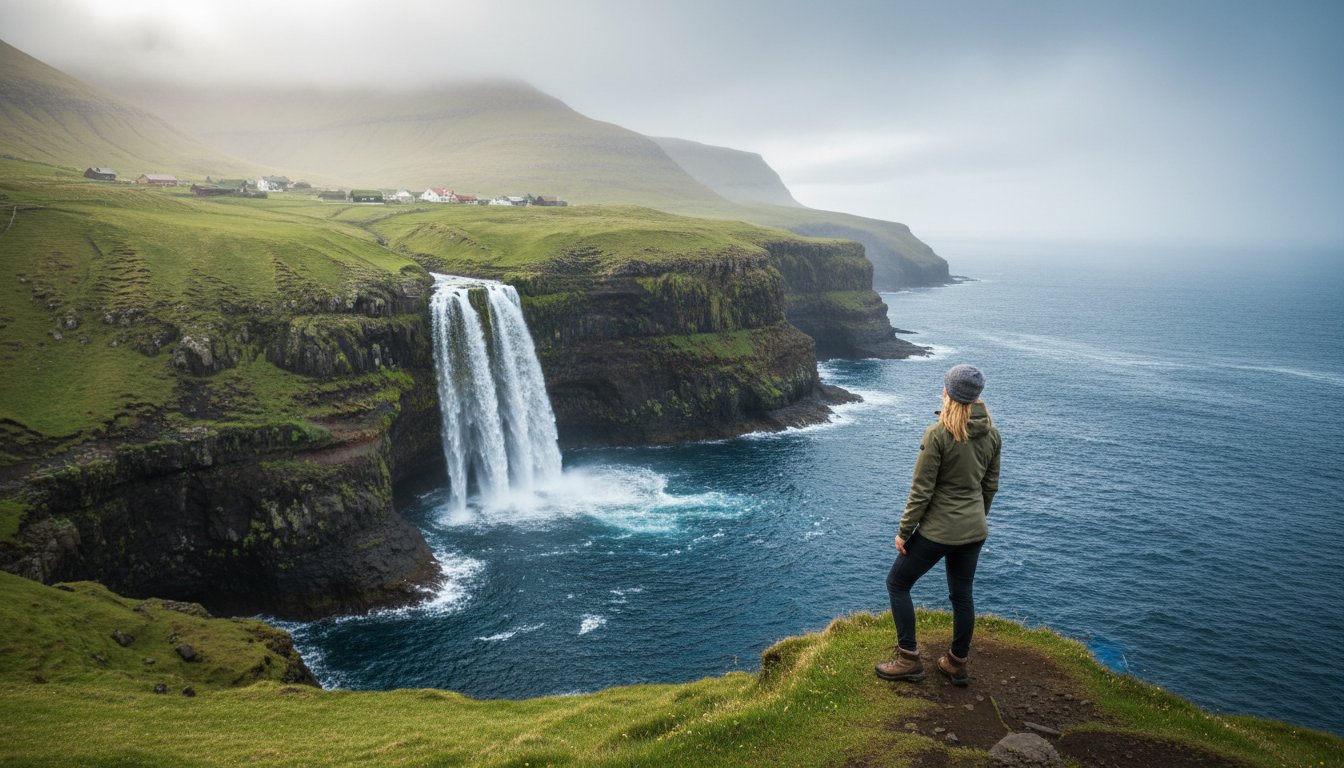
The Faroe Islands are not a destination you simply visit. They are a feeling that begins the moment you dream of their untamed shores, a whisper of ancient sagas carried on a salt-laced wind.
It’s a powerful pull, we know. The vision of ethereal, emerald-green cliffs plunging into a churning cobalt sea, a landscape that feels untouched by the modern world. But translating that dream into reality presents its own challenges: the notoriously fickle weather, the rising cost of transport since 2024, and the debate between a rental car’s freedom and the local charm of public ferries. This is not just another faroe islands travel guide. It is your personally curated key to a seamless 2026 Arctic escape, designed to connect you with the archipelago’s rugged heart and quiet soul.
We will guide you through handpicked accommodations, reveal the most soul-stirring vistas, and provide the precise logistical clarity you need to explore with confidence and wonder.
Key Takeaways
- Discover the latest 2026 flight logistics and how the revolutionary subsea tunnel network has transformed island-hopping.
- Navigate the updated hiking fee system and understand when a local guide is essential for accessing pristine, restricted trails.
- Use our faroe islands travel guide to craft your perfect journey, from handpicked remote cottages to a curated 7-day itinerary.
- Uncover the must-see highlights of the gateway islands, including the ethereal Múlafossur waterfall and the quiet charm of Tórshavn.
Introducing the Faroe Islands: The Land of Maybe in 2026
Imagine a place suspended in the heart of the North Atlantic, a secret held between the shores of Scotland and the volcanic drama of Iceland. This is the realm of the Faroe Islands, an ethereal archipelago of 18 emerald-green islands rising sharply from the ocean, often veiled in a mystical fog. They are sheer, untamed, and breathtakingly beautiful. A world away from the world.
For the discerning traveler of 2026, the Faroes represent more than a destination; they embody a philosophy. The locals have a saying, Læntið kanskje, which translates to “the land of maybe.” It’s a gentle surrender to the elements, an acceptance that a sudden squall might alter your hiking plans, only to reveal a sun-drenched valley an hour later. This mindset is the antidote to the over-scheduled, hyper-connected pace of modern life. It’s about embracing the unexpected, and it’s why this place is becoming the benchmark for intentional travel.
The islands have consciously pivoted away from mass tourism, championing a high-value, low-impact model. Since 2019, their pioneering “Closed for Maintenance” initiative has seen the islands temporarily close popular sites to the public, inviting 100 volunteers to help preserve the fragile landscapes. For you, this means an experience defined by exclusivity and authenticity. It’s a promise of quiet trails, uncluttered vistas, and a genuine connection to a culture that values preservation over profit. This is a journey that gives back.
Here, untamed nature and sophisticated Nordic culture exist in a stunning paradox. You can spend your day hiking to the cliff-hanging lake of Sørvágsvatn, feeling the raw power of the Atlantic, and by evening, be seated in a turf-roofed house in Tórshavn, enjoying a multi-course meal that redefines Nordic cuisine. This is the unique appeal of the Faroes: wild heart, refined soul.
Why Visit the Faroe Islands Now?
In a world where over 1.5 billion people travel annually, the allure of true solitude is the ultimate luxury. The Faroes offer this in abundance. Looking ahead to 2026, the capital of Tórshavn is set to host its year-long ‘Søguslóð’ (Saga Trail) celebration, a series of curated artistic installations and musical events that will bring the ancient Norse sagas to life across the city. Here, nestled in the heart of the wild ocean, lies the last frontier of quiet luxury in the North Atlantic.
Understanding the Climate and ‘Nordic Soul’
To truly appreciate the Faroes, one must embrace its capricious weather. The “four seasons in one hour” adage isn’t an exaggeration; it’s a daily reality that shapes the very essence of the Faroese character. This rugged environment cultivates a philosophy of ‘intentional travel’. Every excursion requires thought and preparation, making each reward-a sunlit moment atop a cliff, a rainbow arching over a remote village-feel earned and profound. This complete faroe islands travel guide is built on this principle of mindful exploration, where the local lifestyle of resilience, community, and deep respect for nature directly influences your experience, encouraging a slower, more meaningful journey.
Planning Your Journey: Logistics, Flights, and Tunnels
An adventure to the Faroe Islands begins not on its rugged cliffs, but in the quiet moments of planning. Crafting a seamless journey is the first step toward immersing yourself in this untamed landscape. This section of our Faroe Islands travel guide is dedicated to the essential logistics that transform a dream into a bespoke reality, ensuring your arrival and exploration are as ethereal as the islands themselves.
Getting to the Archipelago
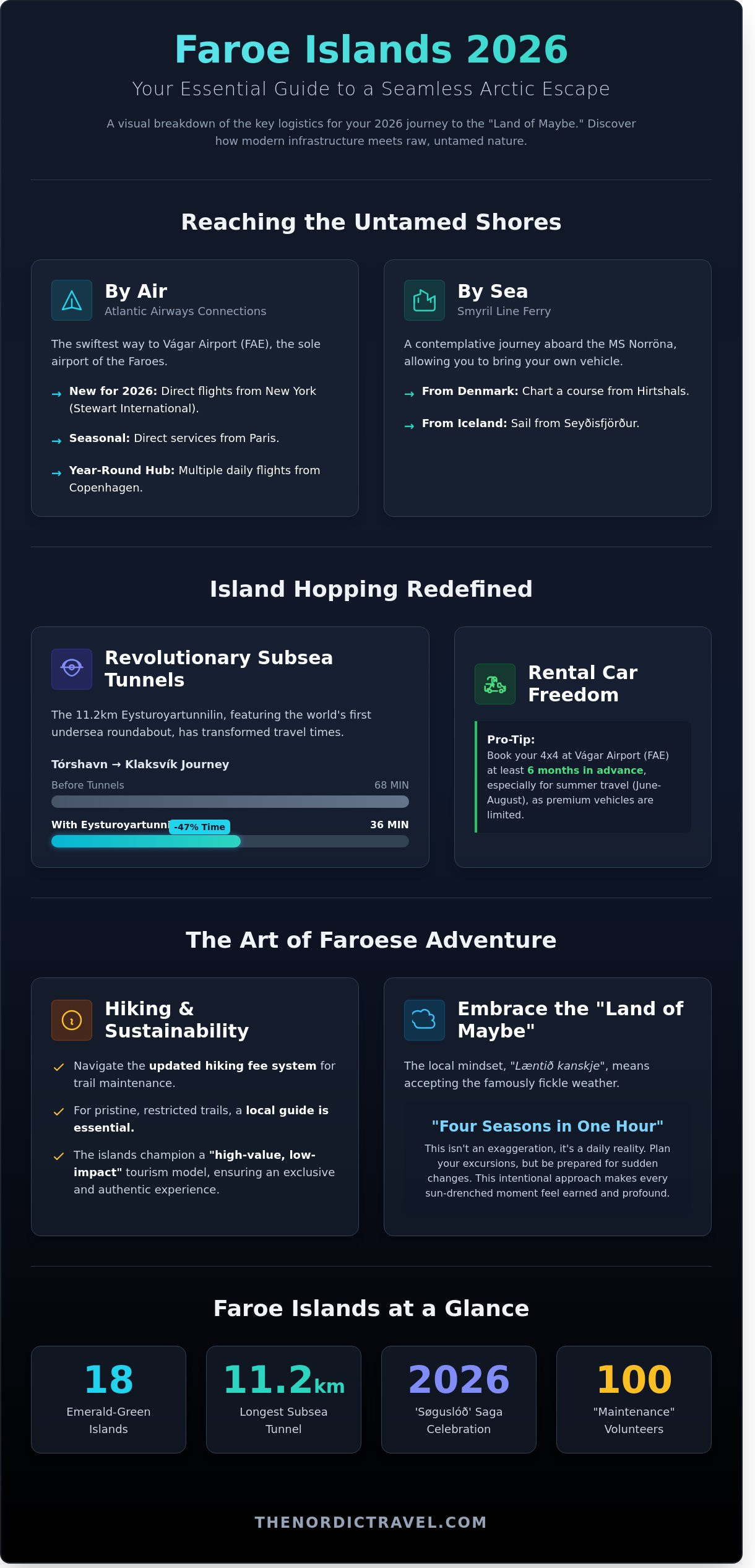
Reaching these remote shores has become remarkably accessible. The national carrier, Atlantic Airways, is set to expand its horizons in 2026, launching direct routes from New York (Stewart International Airport), alongside its established seasonal services from Paris and its year-round hub in Copenhagen. These flights offer the swiftest connection to the heart of the North Atlantic. For a more contemplative arrival, the MS Norröna ferry, operated by Smyril Line, charts a course from Hirtshals, Denmark, or Seyðisfjörður, Iceland. It’s a journey that allows you to witness the vastness of the ocean, arriving with your own vehicle for an extended stay.
Pro-tip: The freedom of the Faroese roads is best experienced with a private vehicle. We recommend booking your rental car for collection at Vágar Airport (FAE) at least six months in advance, particularly for travel between June and August, as the handpicked fleet of premium 4x4s is limited and in high demand.
The Infrastructure of the Islands
The Faroes are a marvel of modern engineering woven into an ancient landscape. Island hopping was redefined with the 2020 opening of the Eysturoyartunnilin, an 11.2km subsea tunnel featuring the world’s first undersea roundabout. This illuminated art installation by Tróndur Patursson is more than a conduit; it’s an experience, cutting travel time between the capital, Tórshavn, and the second-largest town, Klaksvík, from 68 minutes to just 36. Navigating the network is seamless; rental vehicles are equipped with an automated transponder (a tunnilsgjald), and tolls are simply added to your final invoice. The public transport system, while reliable for residents, operates on a schedule that seldom aligns with a photographer’s chase for the perfect ethereal light. To truly unlock the islands’ secrets on your own terms, our team can arrange for a premium 4×4 vehicle as part of your tailor-made Faroe Islands itinerary.
As of 2026, entry requirements for most visitors from the EU, UK, and US remain straightforward, typically requiring only a valid passport for stays up to 90 days. However, the islands possess a unique autonomous status within the Kingdom of Denmark. For the most current and detailed protocols, the Official Government of the Faroe Islands Information portal offers foundational facts. In line with the nation’s deep respect for its pristine environment, discussions continue around a mandatory Sustainable Travel Permit for 2026. This small contribution, expected to be around 50 DKK per visitor, will directly fund trail maintenance and conservation projects, ensuring this paradise remains untouched for generations to come.
A Curated Island Guide: From Vágar to Kalsoy
The Faroe Islands are an archipelago of moments, each island a distinct chapter in a grand, untamed narrative. Your journey begins the moment you land, stepping from the modern world into an ethereal saga of mist, mountains, and sea. This curated guide is your compass to the most profound experiences across these pristine lands, from iconic vistas to the quiet, cultural heart of the nation.
Vágar and the Iconic Landscapes
Vágar is your dramatic welcome. It’s home to Lake Sørvágsvatn, the famous “lake over the ocean.” This breathtaking optical illusion is reached via the Trælanípan hike, a 3-kilometer trail that requires a conservation fee of 200 DKK, payable at the trailhead. We implore you to walk responsibly; the fragile ecosystem depends on visitors staying on the marked path. Nearby, the village of Gásadalur, isolated until a tunnel was blasted through the mountain in 2004, cradles the Múlafossur waterfall. Here, water plunges directly from a green cliffside into the churning North Atlantic. It’s a humbling display of nature’s raw power. For wildlife enthusiasts, the puffin colony on Mykines is legendary, though access is now highly restricted to preserve its delicate environment, with new sustainable tourism protocols expected for the 2026 season.
Tórshavn: The World’s Smallest Capital
On the neighboring island of Streymoy lies Tórshavn, a capital city that feels more like an ancient, soulful village. Its heart is Tinganes, the historic peninsula where Viking chieftains established their parliament in 825 AD. Lose yourself in its narrow, cobbled alleys, walking between traditional turf-roofed houses painted in black tar and deep red. Beyond history, Tórshavn offers a sophisticated present. Discover bespoke knitwear at boutiques like Guðrun & Guðrun or handpicked Nordic designs at Öström. The culinary scene is equally exceptional, offering everything from cozy hospitality to world-class dining.
- Áarstova: For traditional Faroese lamb in a historic, grass-roofed building.
- ROKS: A Michelin Green Star restaurant offering a playful, seafood-focused tasting menu.
- Paname Café: The perfect spot for a quiet coffee and homemade cake inside a charming bookstore.
A short drive from the capital, the island of Eysturoy reveals a landscape of rugged grandeur. It’s an island defined by its deep fjords and soaring peaks, including the 880-meter Slættaratindur, the highest point in the Faroes. The true jewel of Eysturoy is the village of Gjógv, named for the deep, sea-filled gorge that forms its natural harbor. It’s a place of profound tranquility, where colorful houses cluster together against a backdrop of imposing green mountains.
No modern faroe islands travel guide is complete without a pilgrimage to the Northern Isles, specifically to the slender, dramatic island of Kalsoy. A challenging but rewarding hike leads to the Kallur Lighthouse, a solitary sentinel perched on a precipitous cliff. This is the hallowed ground where James Bond met his fate in the 2021 film No Time to Die, a moment now immortalized by a discreetly placed tombstone. Standing here, with the wind whipping around you and the endless ocean below, you’ll understand the wild, cinematic soul of the Faroes. This isn’t just a destination; it’s an experience that stays with you forever.
The Art of Faroese Adventure: Hiking and Sustainability
To walk the ancient sheep paths of the Faroe Islands is to engage in a quiet dialogue with an untamed landscape. It’s an experience that transcends mere sightseeing, connecting you to the very soul of this ethereal archipelago. But this profound connection demands respect. Our comprehensive faroe islands travel guide to hiking is built on a foundation of safety, sustainability, and a deep reverence for the local culture that safeguards these pristine trails.
The rugged, dramatic beauty of the Faroes requires professional respect. The weather here is a living entity, capable of shifting from sun to dense fog in under ten minutes. Trails are often narrow, exposed, and skirt sheer cliffs that drop hundreds of meters into the churning North Atlantic. This is not a landscape for improvisation. It’s a place for preparation, proper gear, and the wisdom to know when to turn back or, better yet, to hire a local guide who reads the mountains and the sky like an open book.
In recent years, the Faroese have pioneered a unique approach to managing their natural treasures. The introduction of a hiking fee system for certain popular trails, such as the iconic path to the Drangarnir sea stacks (priced at 550 DKK per person as of 2024), is not a barrier but a preservation tool. These funds directly support trail maintenance, erosion control, and the landowners who are the traditional custodians of the hills. The official portal, hiking.fo, provides seamless booking for fees and certified guides, ensuring your adventure contributes directly to the land you’ve come to admire. This commitment is epitomized by the globally acclaimed ‘Closed for Maintenance’ initiative, where the islands close major sites for a weekend (scheduled for April 24-26, 2026) to allow 100 international volunteers to work alongside locals, healing the trails and fostering a global community of caretakers.
Top Curated Hikes for 2026
Our handpicked selection of trails offers a perfect cross-section of Faroese splendor, from accessible vistas to challenging ascents. Each one promises a perspective you’ll carry with you long after you’ve left.
- Kallur Lighthouse: Perched on the northernmost tip of Kalsoy island, this hike delivers one of the most sublime and photographed views in the entire North Atlantic. The trail is a guided-only experience (200 DKK per person), ensuring safety and minimal impact on the fragile cliff-edge ecosystem.
- Hvíthamar: For an unparalleled reward-to-effort ratio, this short, accessible climb above the village of Funningur is unmatched. In just 15 minutes, you are greeted with a breathtaking panorama of the Funningsfjørður fjord, a vista that feels both exclusive and utterly wild.
- Slættaratindur: Ascend to the rooftop of the Faroes. At 880 meters, this is the archipelago’s highest peak. The journey to the summit is a rewarding challenge that culminates in a 360-degree view of the entire island chain. On the clearest of days, local legend holds that you can see Iceland’s Vatnajökull glacier, over 550 kilometers away.
Responsible Travel and Local Etiquette
As you explore, remember that nearly every path you walk crosses private land, a vital resource for the islands’ 70,000 sheep. This is the cornerstone of responsible Faroese travel. Following this simple etiquette is not just polite; it’s an essential part of a sustainable faroe islands travel guide.
- Respect private property by staying on marked paths and cairn trails. Always close any gate you open to ensure sheep don’t wander.
- During the critical bird nesting season, from early May to mid-August, be especially mindful of your footing and noise levels to avoid disturbing puffins, oystercatchers, and other ground-nesting species.
- Embrace the ‘leave no trace’ philosophy absolutely. The fragile sub-arctic vegetation can take decades to recover from damage. Pack out everything you pack in.
- A friendly nod or “hey” to a passing farmer is always appreciated. They are the stewards of this landscape, and a small moment of connection enriches the experience for everyone.
Your adventure should give back as much as it takes. Let us help you plan a journey that honors this delicate balance. Allow our local experts to curate your bespoke Faroese hiking experience.
Bespoke Stays and Itineraries: Crafting Your Experience
A journey to the Faroe Islands is not merely a trip; it’s an intimate dialogue with nature. To truly connect with this untamed archipelago, your experience should be as unique as the landscape itself. A thoughtfully crafted itinerary transforms a simple visit into a seamless, personal saga. It’s the difference between seeing the islands and feeling them. This is where our expertise in creating a bespoke faroe islands travel guide for your journey becomes essential.
Where to Stay: The Nordic Travel Picks
Your sanctuary after a day of exploration is paramount. We’ve handpicked accommodations that are more than just a place to rest; they are an extension of the Faroese experience itself.
- Hotel Føroyar: An architectural masterpiece designed in 1983 by Danish architects Friis & Moltke, this hotel’s grass roof and terraced structure seem to grow directly from the hillside above Tórshavn. Every room offers a panoramic, almost ethereal, view of the capital and the fjord beyond.
- Boutique Stays in Reyni: In the heart of Tórshavn’s old town, historic turf-roofed homes have been meticulously restored into exclusive guesthouses. Staying here means waking up to the quiet sounds of the harbour and stepping out into cobblestone lanes that whisper centuries of stories.
- Remote Luxury: For profound solitude, we arrange stays in private, glass-fronted cottages near iconic locations like Gjógv or Saksun. Imagine watching the Atlantic mist roll in from the warmth of your own hearth, completely immersed in the raw, pristine beauty of the islands.
Choosing between a self-drive adventure and a private, guided tour defines the texture of your journey. A self-drive trip offers unparalleled freedom, allowing you to chase the fleeting light and linger at a dramatic cliffside on a whim. The islands’ modern road network and 21 sub-sea tunnels make independent exploration a joy. For a truly seamless experience, however, a private tour with a local expert is unmatched. Your guide unlocks hidden perspectives, shares deep cultural insights, and handles every detail, leaving you free to simply absorb the wonder around you.
Sample 2026 Itinerary Framework
For first-time visitors, our 7-day ‘Classic Faroe’ journey offers a perfect narrative arc, balancing iconic sights with quiet discovery. Think of it as a blueprint for your own tailor-made adventure.
- Days 1-3: Vágar and the Western Wonders. Begin with the essentials. Witness the impossible cascade of Múlafossur waterfall into the ocean, stand in awe above the “floating lake” of Sørvágsvatn, and ferry to Mykines to walk among thousands of puffins (May-August).
- Days 4-5: Tórshavn Culture and the Southern Fjords. Immerse yourself in the Nordic capital. Explore the ancient Tinganes peninsula, relax in cozy cafes, and then journey south to the lesser-visited islands of Sandoy or Suðuroy for a glimpse into a more traditional way of life.
- Days 6-7: The Wild North and Kalsoy Exploration. The final chapter is one of rugged drama. We’ll guide you to the northern islands, culminating in the unforgettable hike to the Kallur Lighthouse on the mythical island of Kalsoy, a truly epic conclusion to your faroe islands travel guide experience.
This is just the beginning of what’s possible. Discover our handpicked Nordic tours and custom itineraries to start crafting your personal story.
Ultimately, a visit to the Faroes is transformative. The sheer scale of the cliffs, the ephemeral quality of the light, and the profound silence of the valleys have a way of recalibrating the soul. It’s an invitation to disconnect from the noise and reconnect with something elemental and true. Your journey here will stay with you long after you’ve returned home.
Craft Your 2026 Faroese Odyssey
The ethereal landscapes of the Faroe Islands are calling. You now hold the keys to unlock this remote archipelago: a clear path through 2026 travel logistics, from its 19 major sub-sea tunnels to updated flight schedules, and a vision for sustainable hiking across its dramatic coastlines. With the knowledge in this faroe islands travel guide as your foundation, you’re prepared to embrace the untamed beauty of the “Land of Maybe.”
But a blueprint is not the journey itself. When you’re ready to transform this vision into a seamless reality, our work begins. As Nordic travel specialists, we use this updated 2026 data to craft bespoke itineraries focused on meaningful, sustainable travel. Let us curate the details, so you can immerse yourself in the wonder. Explore our curated Nordic travel guides and bespoke tours and allow us to design your escape. Your arctic adventure awaits.
Your Faroe Islands Journey: Frequently Asked Questions
Is a trip to the Faroe Islands worth the cost in 2026?
Absolutely, a journey to the Faroe Islands is a worthwhile investment in 2026 for travelers seeking an exclusive escape. While daily expenses can range from 1,800 to 2,500 DKK, the value lies in experiencing its untamed, crowd-free landscapes. This is not a budget destination; it’s a curated experience for those who value the profound beauty of a pristine world, where the return on investment is measured in unforgettable moments and deep tranquility.
Do I really need a rental car to see the Faroe Islands?
Yes, a rental car is indispensable for a truly seamless and personal exploration of the islands. While the public bus and ferry system is efficient for major routes, a car grants you the freedom to discover hidden waterfalls and remote villages on your own schedule. The archipelago’s excellent road network, including sub-sea tunnels like the Eysturoyartunnilin, makes navigating between islands a breathtakingly simple part of the adventure, allowing for a truly bespoke journey.
What is the best month to visit for the best weather?
For the most favorable weather, plan your visit between June and August. During these summer months, you’ll experience the longest days, with up to 19 hours of ethereal light, and average temperatures hovering around 13°C (55°F). While the Faroese climate is famously changeable, this period offers the highest chance for clear skies, making it ideal for hiking the rugged coastlines and capturing the islands’ dramatic beauty. It’s the perfect season for unhurried exploration.
Are the hiking fees mandatory and how do I pay them?
Yes, hiking fees are mandatory on several iconic, privately-owned paths and are a vital contribution to preserving the pristine landscape. For popular routes like the Trælanípan “floating lake” trail (around 200 DKK per person) or the puffin path on Mykines, payment is required. You can typically book and pay online in advance through official sites like hiking.fo, ensuring a seamless start to your adventure while supporting the local landowners who maintain these beautiful trails.
Can I see the Northern Lights in the Faroe Islands?
While it is possible to witness the Northern Lights, it’s a magical, albeit rare, spectacle in the Faroe Islands. The best viewing window is between September and March on clear, dark nights. However, the islands’ famously dramatic and often overcast weather means sightings are less frequent than in other Nordic destinations. Consider the aurora a potential, ethereal bonus to a winter trip focused on rugged, moody landscapes and cozy village life, not the primary goal.
How many days are enough for a complete Faroe Islands travel guide experience?
To truly immerse yourself in the landscape, we recommend 5 to 7 days for a well-paced journey. This duration allows you to explore the core islands of Vágar, Streymoy, and Eysturoy without rushing. For a more comprehensive Faroe Islands travel guide experience, extending your stay to 8-10 days provides the flexibility to venture to the remote Northern Isles or the southern island of Suðuroy, allowing the unpredictable weather to shape a truly unique and personal itinerary.
Is the Faroe Islands safe for solo travelers?
Absolutely, the Faroe Islands is an exceptionally safe and welcoming destination for solo travelers. With a crime rate that is among the lowest in the world, the primary safety consideration is the natural environment itself. The sense of community is strong, and locals are famously hospitable. For the solo adventurer, the islands offer a profound sense of peace and solitude, providing a secure and serene backdrop for connecting with the raw, untamed beauty of the North Atlantic.
What should I pack for the unpredictable Faroese weather?
Layering is the key to comfort in the Faroes, where you can experience four seasons in a single day. The foundation of your wardrobe should be a waterproof and windproof shell jacket and trousers. Beneath this, pack merino wool base layers, a fleece or light insulated jacket for warmth, and sturdy, waterproof hiking boots. A warm hat, gloves, and wool socks are non-negotiable, even in summer, ensuring you’re perfectly prepared for whatever the beautiful, untamed elements present.