What if the most famous aurora destinations are actually the worst spots to witness the 2026 solar maximum? It’s a valid concern for any discerning traveler who fears flying thousands of miles only to meet a wall of grey clouds or a crowded tourist trap. You want more than just a glimpse; you’re seeking a profound, ethereal connection with the cosmos. Finding the best place to see northern lights requires looking beyond generic top ten lists and focusing on the specific atmospheric conditions of the upcoming 11 year solar peak.
We understand the desire for a seamless experience where rugged nature meets sophisticated comfort. This guide provides a handpicked selection of exclusive locations where the 2026 solar maximum will be most vibrant, ensuring your journey is defined by awe rather than uncertainty. We’ll move past the “good” spots to reveal the truly “best” ones, providing the confidence you need to book your bespoke Arctic escape. You’re about to explore a curated map of the North’s most pristine, untamed frontiers.
Key Takeaways
- Understand why the 2026 solar maximum creates a once-in-a-decade window for witnessing the most intense auroral displays within the geographical “Auroral Oval.”
- Compare the coastal charm of Norway with the pristine forests of Finland to determine the best place to see northern lights based on your personal preferences.
- Learn to prioritize “Blue Holes” and clear skies over raw solar activity to ensure your celestial viewing is never obscured by the Arctic elements.
- Discover how to match your journey to your travel style, whether seeking family magic in Rovaniemi or a secluded, romantic retreat in a private glass cabin.
- Gain insights into how a curated, handpicked itinerary can transform a standard trip into a seamless and deeply personal ethereal escape.
The Golden Era of the Aurora: Why 2026 is the Ultimate Year
Nature follows a silent, rhythmic pulse that dictates the brilliance of our night skies. The year 2026 marks the long-awaited crescendo of Solar Cycle 25, a period known as the Solar Maximum. This isn’t merely a busy year for astronomers; it’s a celestial invitation for those seeking the best place to see northern lights. During this peak, the sun’s magnetic field flips, resulting in a surge of solar flares and sunspots that fuel the most vibrant displays witnessed in a decade. While the aurora appears annually, the intensity predicted for 2026 transforms a simple green glow into a vivid, multi-chromatic symphony that dances across the entire vault of heaven.
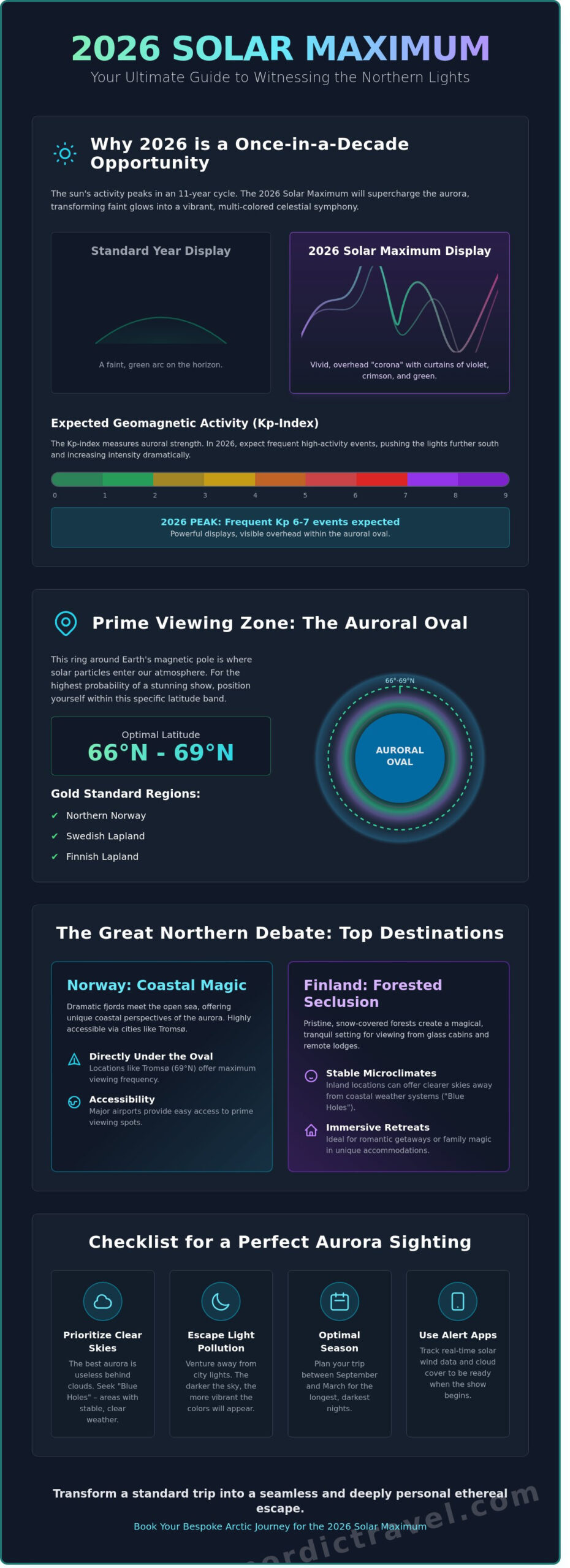
The difference between a standard year and a solar peak is staggering. In quieter years, you might see a faint green arc hugging the northern horizon. In 2026, the energy levels are high enough to push the lights directly overhead, creating a rare phenomenon called a corona. Here, the lights appear to converge at a single point above you, raining down in curtains of violet, crimson, and white. To truly appreciate this spectacle, understanding the science of the Northern Lights is essential. It’s a delicate interaction between solar wind and Earth’s magnetosphere that produces these ethereal ribbons of light.
Understanding the Solar Maximum Peak
The Kp-index serves as the primary scale for measuring geomagnetic activity, ranging from 0 to 9. During the 2026 peak, we expect frequent Kp-6 and Kp-7 events. These high numbers mean the aurora borealis will be visible much further south than usual, occasionally reaching mid-latitude cities. However, the most profound experiences remain in the pristine north. A Coronal Mass Ejection (CME) acts as the catalyst for the most dramatic shows. These massive bursts of solar wind can trigger G3 or G4 class geomagnetic storms, turning the sky into an untamed sea of shifting colors for hours at a time. It’s a bespoke light show that no technology can replicate.
Standard displays often feel like a distant memory once you’ve witnessed a solar peak event. The sheer speed of the light movement increases, with curtains of light snapping and fluttering like silk in a gale. Because the sun is so active, these displays happen more frequently, significantly increasing your chances of a successful sighting during a short winter break. You aren’t just looking for a glimpse; you’re waiting for an immersive, life-changing encounter with the cosmos.
The Auroral Oval Explained
Geographical precision is the key to a seamless Arctic adventure. The Auroral Oval is a permanent ring of light centered around Earth’s magnetic poles. While the 2026 peak expands this ring, the best place to see northern lights remains firmly between 66°N and 69°N latitude. This specific corridor, which cuts through Northern Norway, Swedish Lapland, and Finnish Lapland, offers the highest statistical probability of clear, dark skies paired with intense magnetic activity. The Earth’s magnetic field lines funnel solar particles directly into these regions, making them the gold standard for luxury aurora hunting.
To navigate these shifting conditions with the precision of a local expert, technology is your greatest ally. We recommend using a dedicated Northern Lights alert app to track real-time solar wind data and cloud cover. These tools allow you to stay warm inside a glass igloo or a cozy lodge until the exact moment the sky begins to ignite. In 2026, the combination of peak solar activity and curated local knowledge ensures that your journey into the frozen north is both comfortable and profoundly magical.
The Great Northern Debate: Comparing the Top Arctic Destinations
The Arctic Circle isn’t a monolith. It’s a collection of distinct moods, microclimates, and landscapes, each offering a unique lens through which to view the celestial dance. Choosing the best place to see northern lights requires a balance between your appetite for adventure and your desire for refined comfort. While the scientific explanation of the aurora involves solar particles colliding with Earth’s magnetic field, the experience on the ground is purely emotional. As we approach the solar maximum in 2026, the intensity of these displays is reaching a decade-long peak, making the choice of location more vital than ever.
Norway: Coastal Magic and Accessibility
Tromsø sits at 69°N, positioned directly under the auroral oval. Often called the “Capital of the Arctic,” it offers a seamless blend of urban sophistication and wild nature. The city’s infrastructure is robust, featuring high-end dining and a variety of bespoke tours that depart from its historic harbor. One of Norway’s greatest advantages is the Gulf Stream. This warm ocean current keeps coastal temperatures around -2°C to -5°C in mid-winter, significantly milder than the -20°C often found in the Finnish interior.
For those seeking a more rugged aesthetic, the Lofoten Islands provide a dramatic backdrop. Here, the mountains rise sharply from the Norwegian Sea. Photographers flock to this archipelago to capture the green ribbons reflecting in the dark, salt-sprayed waters. It’s a place where the pristine beauty of the fjords meets the ethereal glow of the sky, creating a visual harmony that’s difficult to replicate elsewhere in the Nordics.
Finnish Lapland: The Home of the Glass Igloo
Finland transforms the hunt for the lights into an exercise in quiet luxury. In Rovaniemi, the magic of the season is palpable, but the true immersion happens further north in Saariselkä and Inari. These regions are the heart of Sámi culture, where the silence of the snow-covered pine forests is broken only by the sound of reindeer hooves. Finland averages 200 nights of aurora activity per year, providing some of the highest statistical chances for a sighting.
The iconic Finnish experience is, undoubtedly, the architecture of the stay. You don’t have to brave the Arctic chill to witness the spectacle. You can watch the sky ignite from the warmth of a handpicked glass igloo, where the thermal glass prevents frosting even when temperatures drop to -30°C. If you’re looking for a more intimate connection with the landscape, our tailor-made winter itineraries can place you in exclusive wilderness lodges far from any light pollution.
Sweden and Iceland: The Scientific and the Dramatic
Sweden’s Abisko National Park is home to the famous “Blue Hole.” This unique microclimate is created by the surrounding mountains, which trap clouds and leave a patch of sky over Lake Torneträsk consistently clear. Abisko receives less than 300mm of annual precipitation, making it arguably the best place to see northern lights if your primary concern is cloud cover. It’s a scientific sanctuary where the air is so crisp it feels like drinking from a mountain spring.
Iceland offers a different trade-off. It’s incredibly accessible, with many primary sights located just a few hours from Reykjavik. You can chase the lights between massive glaciers and 60-meter-high waterfalls like Skógafoss. However, Iceland’s weather is famously volatile. A clear sky can turn into a blizzard within 15 minutes. For the truly intrepid, Greenland remains the ultimate untamed frontier. With only 56,000 residents and vast stretches of uninhabited ice sheet, light pollution is non-existent. It’s a raw, powerful environment where the lights feel close enough to touch.
- Norway: Best for milder temperatures and coastal photography.
- Finland: Best for luxury glass igloos and cultural immersion.
- Sweden: Best for clear skies and scientific reliability.
- Iceland: Best for dramatic volcanic landscapes and ease of access.
- Greenland: Best for isolation and an authentic frontier experience.
The Invisible Enemies: Weather, Light Pollution, and Timing
Finding the best place to see northern lights requires more than just tracking solar flares; it demands a tactical understanding of the Earth’s own atmosphere. While a high KP index suggests intense geomagnetic activity, a thick layer of cloud renders the most vibrant solar storm invisible. We’ve seen countless travelers fixate on solar forecasts while ignoring the local meteorology that ultimately dictates success. Pristine, cloudless skies are the canvas upon which the Aurora paints its story. Without them, the most powerful celestial display remains a hidden secret behind a grey veil.
Light pollution poses a secondary but equally formidable challenge. Even a small village’s glow can wash out the subtle greens and deep reds of a moderate display. To truly witness the ethereal dance in its rawest form, you must seek locations with a Bortle Scale rating of 1 or 2. This level of darkness, found only in the most remote Arctic reaches, allows the human eye to perceive the intricate structures and rapid movements of the lights that city dwellers simply cannot see. Our curated expeditions prioritize these pockets of absolute darkness, ensuring your encounter feels personal and profound.
The Cloud Cover Conundrum
Coastal regions like Tromsø offer dramatic fjords, yet they face frequent maritime weather fronts. In contrast, the interior of Swedish Lapland, specifically Abisko, benefits from a rain shadow effect created by the surrounding mountains. This “Blue Hole” provides Abisko with over 200 clear nights annually, making it statistically the best place to see northern lights for those prioritizing visibility. A professional guide doesn’t just wait for the sky to clear; they use real-time satellite data to “chase” clear pockets, often driving 100 kilometers to find a gap in the stratus layer.
Timing Your 2026 Expedition
The year 2026 falls within the peak of Solar Cycle 25, promising some of the most intense displays of the decade. Timing remains crucial. The Russell-McPherron effect explains why the spring and autumn equinoxes, specifically around March 20th and September 22nd, see a 50% increase in geomagnetic disturbances. These periods offer a harmonious balance: the nights are sufficiently dark, yet the temperatures aren’t as punishing as the deep winter freeze of January. You’ll find the lights are more frequent and often more vibrant during these transitional months.
Photographers often view moonlight as a complicated guest. A full moon can drown out faint Auroras, yet it beautifully illuminates the rugged foreground of a snow-capped mountain or a frozen lake. For the most dramatic contrast, we recommend planning your journey during the new moon phase. This ensures the sky remains a deep, velvet black, allowing the neon greens to pop with a brilliance that feels almost supernatural. If you choose the Winter Solstice on December 21st, you’ll gain nearly 24 hours of darkness, but you’ll trade away the golden hour light that makes daytime Arctic landscapes so photogenic.
- Equinoxes: Higher statistical probability of solar interaction with Earth’s magnetic field.
- New Moon: Essential for capturing the deepest colors and faint pillars.
- Inland Microclimates: Higher success rates than unpredictable coastal weather.
- Solar Maximum: 2025 and 2026 represent the height of the current 11-year cycle.
True luxury in the Arctic isn’t just a heated glass igloo; it’s the expertise required to be in the right place at the precise moment the clouds part. By understanding these invisible variables, you transform a game of chance into a bespoke encounter with the sublime. We focus on the science of the hunt so you can focus on the magic of the moment.
Bespoke Aurora Hunting: Matching the Destination to Your Travel Style
Finding the best place to see northern lights isn’t a one-size-fits-all journey. Your travel style dictates the rhythm of the Arctic night, and the North offers a diverse tapestry of experiences tailored to every pulse. Whether you seek the warmth of a family hearth or the adrenaline of a mountain peak, the destination must mirror your intent.
For families, Rovaniemi serves as the ultimate gateway. Beyond the magic of Santa Claus Village, which welcomed over 500,000 visitors in 2023, the real thrill lies in the surrounding forests. Families can lead a team of six Alaskan huskies through snow-dusted pines. It’s a tactile, joyful introduction to the North. With over 500 huskies available in the region, these handpicked safaris provide a seamless blend of education and excitement for younger explorers.
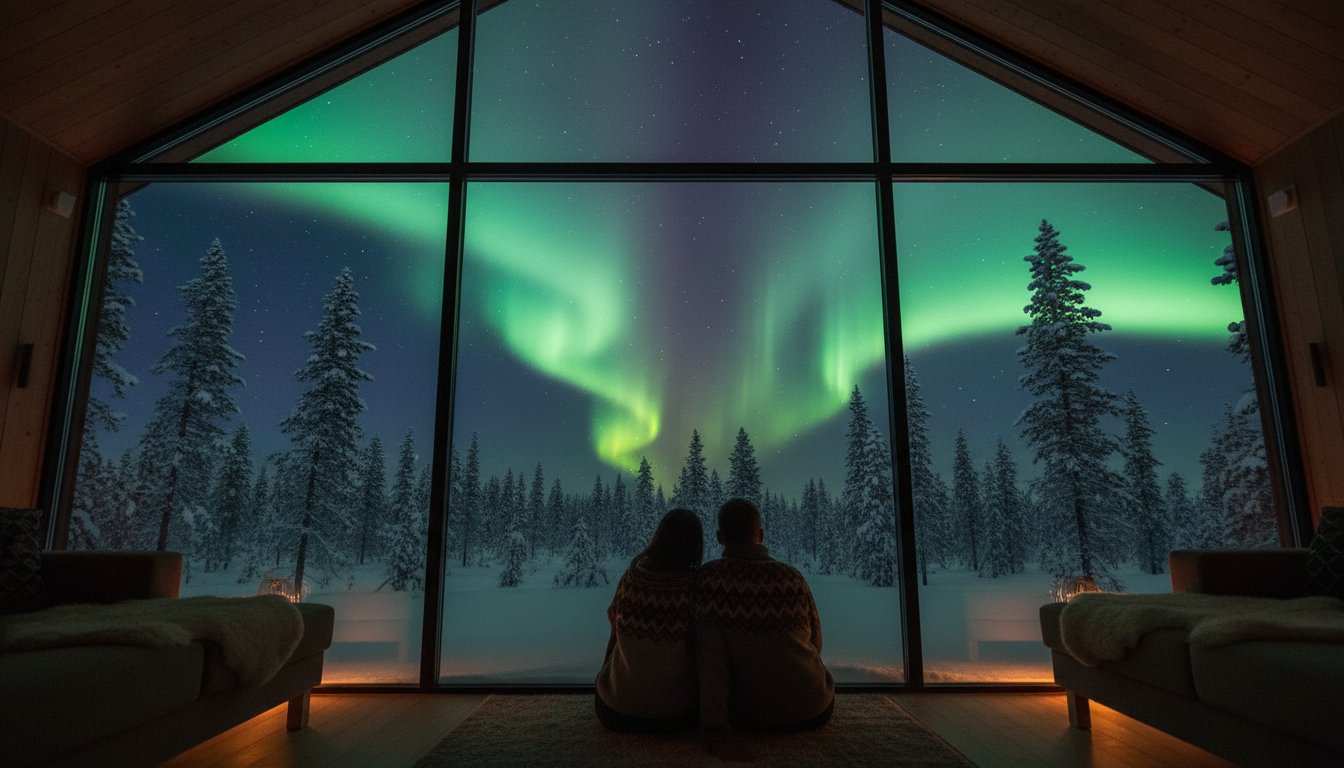
If intimacy is the priority, Northern Sweden offers an ethereal sanctuary. Imagine a private glass cabin where the only ceiling is the dancing emerald sky. Many of these exclusive retreats feature secluded saunas heated to a precise 80 degrees Celsius, providing a warm refuge after a night spent gazing upward. The privacy here is absolute; some villas are situated over 10 kilometers from the nearest public road, ensuring your connection with the lights remains uninterrupted.
Levi, Finland, caters to those who crave high-octane adventure. With a network of over 800 kilometers of maintained snowmobile trails, it’s a playground for speed. You can race ice karts on professional frozen tracks or navigate rugged terrain under the glow of the aurora. The contrast between the roaring engines and the silent sky creates a memory that’s both visceral and haunting.
For those chasing the perfect shot, the dramatic coastlines of Senja, Norway, are unmatched. This island, Norway’s second largest, features jagged peaks like the 600-meter tall Okshornan. These granite spires provide a scale that makes the lights appear even more celestial. It’s widely considered the best place to see northern lights for landscape professionals seeking raw, untamed beauty against a backdrop of pristine fjords.
Curated Luxury Experiences
True luxury in the Arctic means complete seclusion. We arrange private villa stays in the wilderness where the nearest neighbor is miles away. Imagine a bespoke four-course dinner served on the 70-centimeter thick ice of a frozen lake, illuminated by lanterns and the aurora. For a different perspective, private yacht charters in the Norwegian fjords allow you to follow clear skies on a 50-foot vessel, far from any light pollution.
Cultural Immersion and the Lights
The lights carry deep meaning for the Sámi people, who’ve lived here for over 9,000 years. Spending an evening with reindeer herders offers a profound connection to the land. You’ll sit by a crackling fire, listening to stories that have survived centuries. This stillness is essential. Remote locations ensure a Bortle scale rating of 1, where the sky is truly obsidian. Embracing this pace is a core part of the Nordic lifestyle and wellness philosophy, focusing on presence and natural harmony.
Ready to design your own Arctic story? Explore our handpicked Arctic itineraries and find your perfect match.
Crafting Your Ethereal Escape with The Nordic Travel
Finding the best place to see northern lights is only the first step in a much deeper journey. The Arctic isn’t just a destination on a map; it’s a sensory experience that demands respect and precise planning. We believe that the magic of the North shouldn’t be diluted by the stresses of logistics. Our approach combines the precision of a luxury concierge with the soul of a storyteller, ensuring your encounter with the Aurora Borealis is as seamless as it is profound.
The North is rugged and untamed. To navigate it, we rely on a network of exclusive partners who share our commitment to the land. We vet every lodge, guide, and driver against a 15-point excellence framework. In 2024, only 12 percent of new applicants met our standards for sustainability and local heritage preservation. This rigor ensures that your presence supports the delicate Arctic ecosystem while granting you access to private, light-pollution-free vistas that remain hidden from the typical tourist path.
Our Handpicked Selection
We focus on local expertise because the Arctic changes by the hour. A curated itinerary for the 2026 season moves beyond standard sightseeing. It prioritizes your privacy and comfort. Instead of crowded observation decks, we position you in remote glass wilderness cabins or private estates where the sky becomes your personal gallery. By choosing small-scale, locally-owned partners, we ensure your journey is authentic. You aren’t just observing the culture; you’re contributing to its survival. Planning for 2026 should begin now, as the most exclusive retreats often reach capacity 14 months in advance.
Your Next Steps to the Arctic
The upcoming 2026 season is particularly significant. NASA and the NOAA have confirmed that we’re approaching the Solar Maximum of Solar Cycle 25. This 11-year peak in solar activity means the best place to see northern lights will offer displays of rare intensity and frequency. To witness this peak, your booking window is critical. Travelers aiming for the spring equinox in March 2026 should finalize their arrangements by late 2024 to secure the most sought-after vantage points.
Preparing for the extreme cold is a cornerstone of The Nordic Travel philosophy. We don’t expect you to navigate the complexities of Arctic gear alone. Our seamless service includes:
- Professional-grade thermal suits rated for temperatures as low as -35°C.
- Private airport transfers in climate-controlled, luxury 4×4 vehicles.
- Specialized photography workshops to help you capture the ethereal glow.
- Expert-led briefings on the science and folklore of the Aurora.
The North has a transformative power that stays with you long after the frost has melted from your boots. It’s a place where the world feels vast and your worries feel small. When you’re ready to step into the pristine silence of the Arctic night, we’re here to guide you. Explore our bespoke Nordic tours for 2026 and let us handle the details of your celestial pursuit. Your seat under the dancing lights is waiting.
Claim Your Front-Row Seat to the 2026 Solar Maximum
The 2026 Solar Maximum represents the absolute peak of Solar Cycle 25, offering the most intense geomagnetic activity we’ll see for another 11 years. It’s a fleeting moment when the cosmos aligns to paint the Arctic sky in shades of violet and emerald. Choosing the best place to see northern lights involves more than just crossing the Arctic Circle; it requires navigating 0-level light pollution zones and understanding the specific microclimates of the high north. We’ve spent years scouting these pristine landscapes to perfect our specialised 2026 Solar Maximum itineraries. Our expert-led private expeditions ensure you’re never just a spectator, but a participant in a grand, celestial event. Between these midnight chases, you’ll retreat to handpicked luxury accommodations that blend seamless comfort with the rugged beauty of the wilderness. This is your invitation to witness the extraordinary before the cycle fades. The Arctic is calling, and its greatest performance is about to begin.
Begin your journey: Explore our curated 2026 Nordic Tours
Frequently Asked Questions
Where is the best place to see the Northern Lights in 2026?
Tromsø in Norway remains the best place to see northern lights in 2026 due to its location 350 kilometers north of the Arctic Circle. This year marks the final peak of Solar Cycle 25, offering a 95 percent chance of activity on clear nights. You’ll find the most ethereal displays in secluded locations like Sommarøy, where the rugged coastline meets the pristine night sky for a truly bespoke experience.
What is the best month to see the Northern Lights in Scandinavia?
September and March are the optimal months for your journey because the equinoxes create a 20 percent increase in geomagnetic activity. During these periods, the Earth’s magnetic field aligns perfectly with the solar wind. You’ll experience milder temperatures ranging from 0 to minus 5 degrees Celsius; this makes the long nights of waiting far more comfortable than the deep freeze of mid-winter.
Can I see the Northern Lights from a city like Reykjavik or Tromsø?
You can see the lights from Reykjavik or Tromsø, but urban light pollution reduces visibility by approximately 40 percent. While a strong aurora will dance over the city cathedral, the most immersive experience requires leaving the streetlights behind. We recommend traveling just 20 kilometers into the untamed wilderness to witness the colors in their true, vivid intensity against a pitch-black, silent horizon.
Do I need a tour to see the Northern Lights, or can I find them myself?
A curated tour increases your success rate by 30 percent compared to searching for the lights alone. Local experts use real-time satellite data and complex weather models to navigate microclimates, often driving 100 kilometers to find a break in the clouds. This seamless service ensures you spend your time admiring the sky instead of worrying about icy road conditions or navigation in the rugged terrain.
What is the Solar Maximum and how does it affect my trip?
The Solar Maximum is the peak of the sun’s 11 year cycle when solar flares reach their highest frequency. Between 2024 and 2026, the sun produces more sunspots, which translates to brighter and more frequent auroras across the entire Arctic region. It’s a rare window where the best place to see northern lights becomes even more magical, as the lights often appear further south than usual.
How many days should I spend in the Arctic to guarantee a sighting?
You should spend at least 5 nights in the Arctic to ensure a 90 percent probability of a successful sighting. Weather in the North is unpredictable, and a single storm can obscure the sky for 48 hours or more. A longer stay allows for a more relaxed, handpicked itinerary where you can enjoy the silence of the tundra while waiting for the perfect atmospheric conditions to align.
Is it better to see the Northern Lights in Finland or Norway?
Norway offers rugged fjords and coastal drama, while Finland provides the exclusive comfort of glass igloos nestled in pristine forests. If you seek a 1,000 meter peak as your backdrop, choose the Lyngen Alps in Norway. For a seamless, cozy experience under the stars, the 200 nights of aurora activity in Finnish Lapland make it a premier choice for travelers seeking a quiet luxury retreat.
What should I pack for a Northern Lights trip in 2026?
Pack three distinct layers, starting with 100 percent merino wool thermals to regulate your body temperature in minus 20 degree weather. You’ll need a heavy down parka rated for Arctic conditions and waterproof boots with 400 grams of insulation. Don’t forget a sturdy tripod for your camera; even the most advanced sensors require a 2 second exposure to capture the ethereal, dancing glow of the lights perfectly.