What if the most profound moment of your Arctic expedition isn’t found in the green flicker of the sky, but in the velvet silence of the tundra itself? It’s a familiar ache for many of the 6.5 million travelers who venture into these high latitudes each year; you’ve traveled thousands of miles only to find the clouds refuse to part. You might feel a sting of regret as social media feeds fill with vibrant ribbons of light, leaving you wondering what to do if you miss the northern lights during your precious window of time. It’s important to remember that the North doesn’t owe us a show, but it always offers a story.
We’re here to help you transform that quiet sky into a bespoke journey of discovery. This guide reveals how to spot the ethereal, camera-only glows you might be overlooking and introduces handpicked Arctic experiences that rival any celestial display. You’ll gain a refined, professional strategy for your next attempt, ensuring your pursuit of the untamed Aurora is both seamless and deeply rewarding. Your time in the pristine wilderness is a gift, and we’ll ensure you find the magic hidden within the rugged Arctic night.
Key Takeaways
- Understand the ethereal science behind the aurora and why the Arctic’s untamed nature makes every successful sighting a rare, handpicked gift.
- Learn the biological secrets of human night vision and why your camera often reveals a hidden glow that the naked eye might overlook.
- Explore sophisticated alternatives and what to do if you miss the northern lights to ensure your Arctic journey remains a curated masterpiece of discovery.
- Master the art of the “redemption trip” with expert strategies for 2026, focusing on seamless logistics and resilient Scandinavia trip planning.
- Adopt “The Nordic” philosophy to transform your perspective, finding profound inner peace and luxury in the deep silence of the pristine northern landscape.
Understanding the Ethereal Chase: Why the Lights Remain Elusive
The Arctic is a realm of untamed beauty, a place where nature follows its own ancient script rather than a tourist itinerary. You may have traveled thousands of miles, fueled by the hope of seeing emerald ribbons dance across the sky, only to find a silent, velvet void. It is natural to feel a pang of disappointment. This landscape is rugged and unpredictable; it does not yield its treasures on command. When you are wondering what to do if you miss the northern lights, the first step is acknowledging that the “Aurora Chase” is not a scheduled performance, but a rare meeting of cosmic forces. It requires a perfect alignment of solar wind, clear skies, and impeccable timing.
The science behind this phenomenon is as complex as it is beautiful. To understand what causes the northern lights, one must look to the sun. Charged particles travel across the vacuum of space to collide with Earth’s atmosphere, channeled toward the poles by our planet’s magnetic field. Most sightings occur within the Auroral Oval, a permanent ring of activity centered over the geomagnetic poles. However, being inside this zone is only half the battle. We are currently navigating Solar Cycle 25, which began in 2019 and is expected to reach its peak in 2024 or 2025. This period offers the most frequent and intense solar activity we have seen in over a decade, yet even during a solar maximum, the Arctic night remains a mystery that cannot be fully solved.
The Science of the “No-Show”
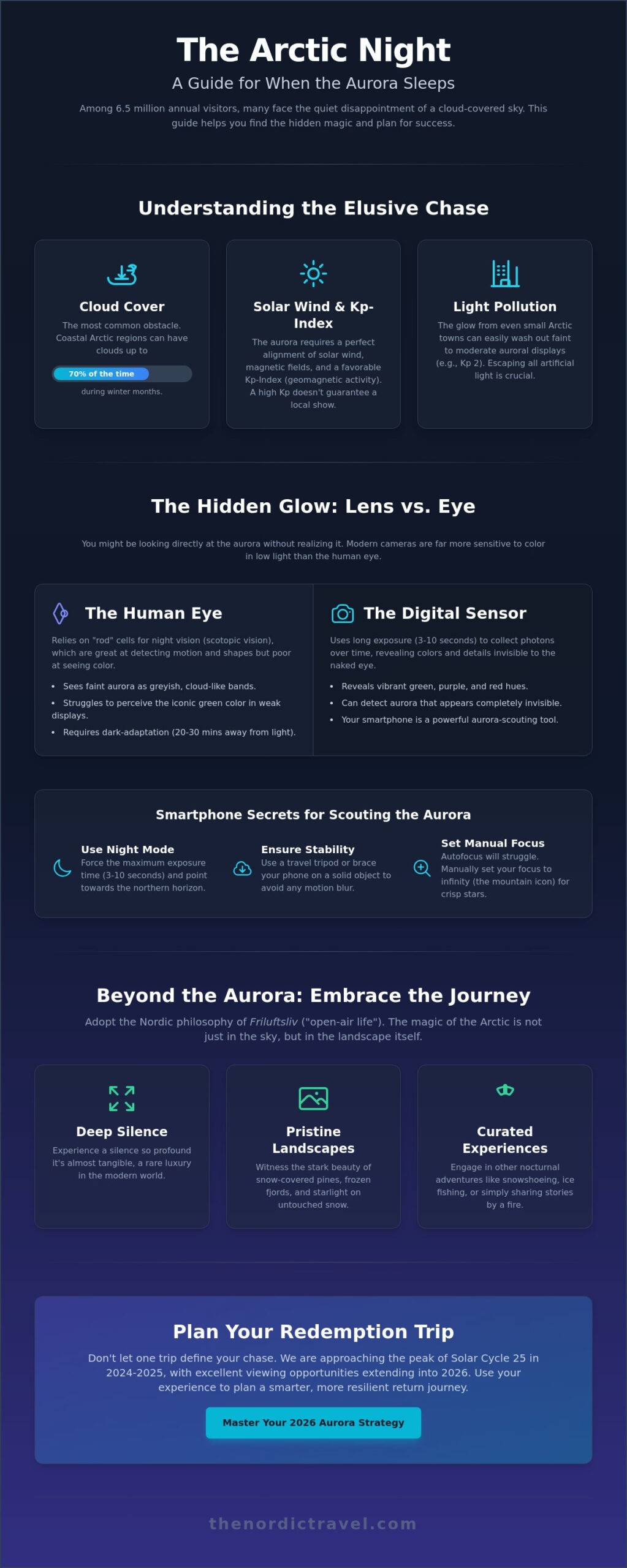
Cloud cover is the most frequent thief of the aurora, often obscuring the show even when solar activity is high. Meteorologists note that coastal regions in the Arctic can experience cloud cover up to 70% of the time during winter months. Then there is the Kp-index, a scale from 0 to 9 used to characterize the magnitude of geomagnetic storms. While a Kp 5 indicates a strong storm, it does not guarantee a local show if the solar wind’s polarity is not aligned. Furthermore, the “glow” of Arctic hubs can wash out faint displays. Escaping light pollution is essential; even a small town’s amber lights can mask the ethereal flicker of a Kp 2 display.
Reframing the “Failed” Expedition
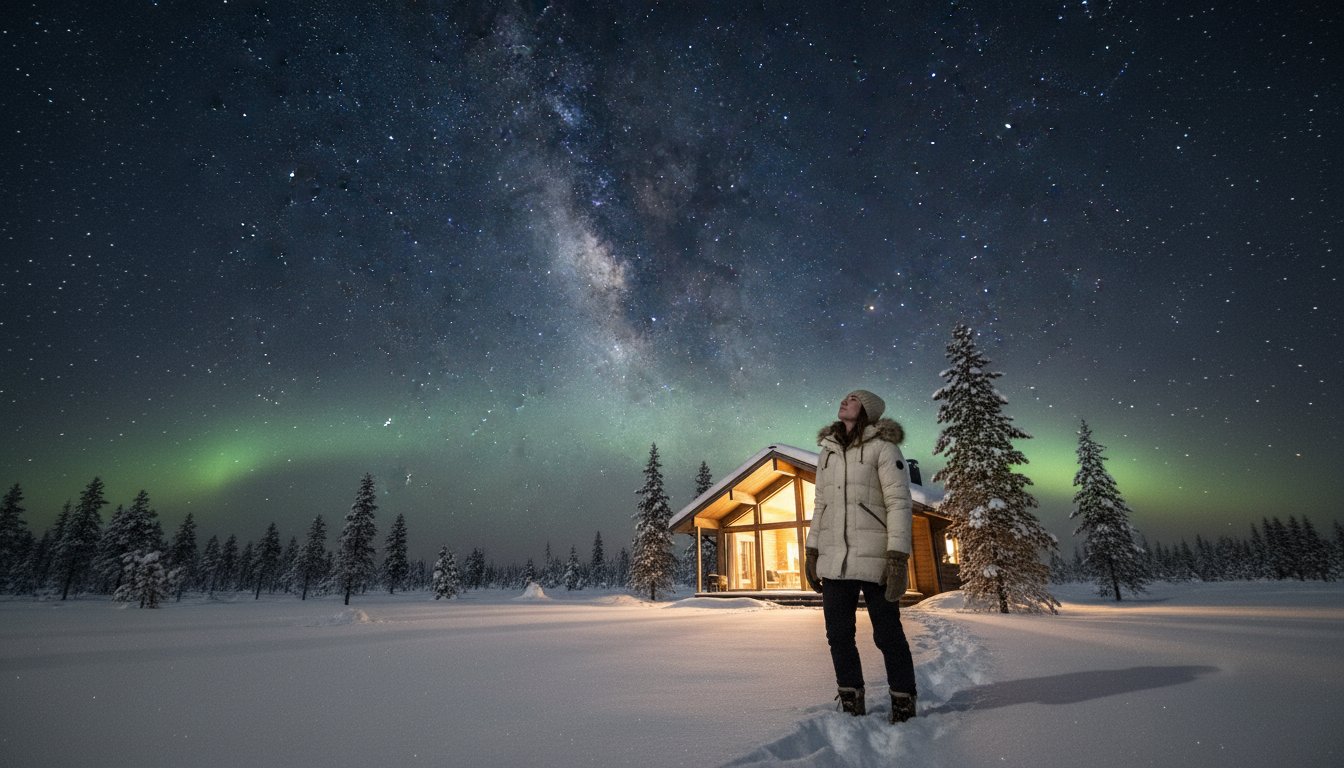
In the Nordic tradition, there is a philosophy known as Friluftsliv, or “open-air life.” It is the art of embracing the outdoors regardless of the weather or the outcome. When considering what to do if you miss the northern lights, look to the chase itself as a curated adventure into the wild. The Arctic night is never truly empty. It is filled with the scent of crisp pine, the crunch of pristine snow underfoot, and a silence so deep it feels tangible. Even without the green fire of the aurora, the starlight reflecting off a frozen fjord is a masterpiece. This is a bespoke journey into one of the world’s last frontiers, where the absence of the lights allows the subtle magic of the landscape to take center stage.
The Lens vs. The Eye: Tricks to Find the Hidden Glow
The Arctic night is a master of disguise. You might stand on a rugged coastline, eyes fixed on the horizon, wondering why your companion’s screen glows with emerald fire while you see only shadows. This discrepancy isn’t a failure of luck; it’s a matter of biology. Human eyes utilize scotopic vision in the dark, relying on cells called rods that struggle to detect color. Digital sensors possess no such limitation. They drink in light over seconds, stacking photons to reveal the ethereal truth hidden from our biological limits.
Knowing what to do if you miss the northern lights often begins with realizing you might actually be looking right at them. To maximize your chances of seeing the aurora, you must learn to bridge the gap between the mechanical lens and the human spirit.
Smartphone Secrets for the Arctic Night
Modern technology allows us to peer through the veil of the untamed north. If the sky looks empty, use your smartphone as a scout. On an iPhone 15 or a Samsung Galaxy S24, the “Night Mode” acts as a temporary set of super-human eyes. Set your device to its maximum exposure time, often 3 to 10 seconds, and point it toward the northern horizon. If that faint, greyish “cloud” appears green on your screen, you’ve found the Lady.
- Stability is Paramount: Even a 0.5-second micro-vibration can blur the light. Use a travel tripod or prop your phone against a pristine block of ice.
- Manual Focus: Set your focus to “infinity.” If the camera hunts for focus in the dark, the image will remain a charcoal blur.
- The Scout Method: Use the camera every 15 minutes. It can detect sub-visual activity long before the human eye registers the movement.
Naked Eye Observation Techniques
While technology provides a window, the soul craves a direct connection. To see the aurora with your own eyes, you must respect the physiology of sight. Dark adaptation is a fragile process. It takes exactly 20 minutes for your eyes to produce the rhodopsin needed for peak night vision. A single glance at a bright smartphone screen or a car headlight resets this clock instantly.
Try the “Averted Vision” technique. Instead of staring directly at a suspected glow, look 15 degrees to the side of it. This utilizes the peripheral parts of your retina, which are more sensitive to faint light. You’ll often see a shimmering movement in the corner of your eye that disappears when you look directly at it. Distinguishing “Auroral Haze” from standard clouds is simple: if you can see stars shining through the mist, it’s the aurora. If the stars are blocked, it’s merely a cloud. For those seeking a truly bespoke Arctic experience, mastering these subtle cues transforms a quiet night into a hunt for celestial magic.
Beyond the Aurora: Curated Nocturnal Experiences in the North
The Arctic night is not a void; it’s a canvas of “Deep Silence” and untamed beauty. While many travelers arrive with a singular focus, understanding what to do if you miss the northern lights begins with embracing the concept of “Dark Sky Tourism.” This isn’t a consolation prize. It’s a bespoke immersion into a landscape where artificial light hasn’t touched the horizon for centuries. In these pristine environments, the absence of the green dance allows the true texture of the cosmos to emerge. It’s a chance to witness the rugged, ethereal stillness of the North in its most private form. For those seeking a deeper connection, exploring Arctic travel inspiration reveals that the night holds secrets far beyond geomagnetic storms.
The Magic of Arctic Stargazing
Without the vibrant glare of the aurora, the celestial ceiling becomes infinitely more complex. The Milky Way reveals its dusty lanes with a clarity impossible in lower latitudes. You might witness a “Moonbow” or a lunar halo, rare optical phenomena where moonlight refracts through ice crystals in the frozen air. To truly appreciate this, consider booking a private, expert-led astronomy session in the wilderness. These curated encounters move beyond simple observation. While NOAA’s aurora viewing tips often focus on the Kp index and geomagnetic activity, a dedicated astronomer focuses on deep-space constellations and the 88 recognized star patterns. In the 2024 winter season, dark sky preserves in Scandinavia reported a 20% increase in visitors specifically seeking these “quiet night” experiences, proving that the stars are a standalone destination.
Nocturnal Culture and Storytelling
When the sky remains dark, the heart of the North moves toward the fire. Entering a “Lavvu,” the traditional Sámi tent, offers a sensory shift that no photograph can capture. The scent of birch smoke and the resonance of “Joik” singing create a spiritual bridge to the land. This traditional singing isn’t just music; it’s an evocation of a person, place, or animal. It’s a profound way to understand what to do if you miss the northern lights by connecting with the people who have thrived under these stars for millennia.
Alternatively, nighttime snowshoeing or husky sledding allows you to focus on the sounds and scents of the forest. Without the distraction of the lights, your other senses sharpen. You hear the rhythmic breath of the dogs and the specific “crunch” of snow at minus twenty degrees. It’s a seamless blend of adventure and mindfulness, where the lack of visual spectacle is replaced by a heightened awareness of the Arctic’s untamed pulse. These handpicked experiences ensure the night remains magical, regardless of solar activity.
Planning for Resilience: How to Maximise Your 2026 Odds
Missing the celestial dance of the aurora is a heartache every Arctic traveler understands. If you are wondering what to do if you miss the northern lights, the answer lies in a more resilient, curated strategy for your next journey. The year 2026 marks a pivotal moment in the solar cycle, offering a rare window for redemption. Mastering the art of Scandinavia trip planning requires more than a simple hotel booking. It demands a deep understanding of the Three Pillars: Location, Duration, and Season.
A bespoke itinerary isn’t just about luxury; it’s about flexibility. The Arctic environment is untamed and unpredictable. By choosing a tailor-made approach, you ensure that your schedule can shift as the weather does. This fluidity transforms a rigid holiday into a seamless pursuit of the ethereal.
Strategic Location Selection
Reliability exists within the Auroral Zone, specifically between 66 and 69 degrees North. Destinations like Tromsø, Abisko, or the pristine reaches of Finnish Lapland offer the highest statistical probability for sightings. However, geography is only half the battle. Weather remains the ultimate gatekeeper. We recommend choosing locations with diverse micro-climates. A coastal fjord might be shrouded in mist while a valley just 100km inland remains clear and crisp. Handpicked private guides often act as “Mobile Basecamps,” using local expertise to outrun cloud cover and find those elusive pockets of starlight.
The “Five-Night Rule” for Success
Time is the most valuable currency in the Arctic night. Statistical evidence shows that a stay of 5 to 7 nights increases your sighting odds to over 87 percent. Short weekend trips are a gamble, but a week-long residency is a calculated strategy. While it’s tempting to check “Aurora Alerts” every five minutes, don’t let the data dictate your joy. Use technology as a tool, not a master. For a deeper dive into the technicalities of solar winds and Kp-indices, consult our guide on Seeing the Northern Lights. This approach ensures you aren’t just chasing a light; you’re immersing yourself in a rugged, magical landscape where the discovery is as rewarding as the destination.
When you focus on the quality of the experience rather than just the result, you find that the Arctic always gives back. Whether it’s the silence of a frozen lake or the warmth of a crackling fire, the magic is there. Planning for 2026 is your chance to turn a missed opportunity into a curated masterpiece of travel.
Explore our handpicked 2026 Arctic itineraries and secure your redemption journey.
The Nordic Travel Philosophy: Finding Magic in the Journey
The Arctic does not end where the clouds begin. It is a vast, untamed theater where the Aurora is merely one performer in a much larger, more profound production. True discovery happens when you stop chasing a single phenomenon and start embracing the “The Nordic” feeling. This is a specific state of being; it is the intersection of pristine, rugged nature and the seamless, quiet luxury that defines our corner of the world. It is the silence of a snow-covered birch forest at midnight and the ethereal glow of the blue hour reflecting off a frozen fjord.
If you find yourself wondering what to do if you miss the northern lights, look toward the connections you’ve made. Curate your memories around the steam rising from a wood-fired sauna, the rich flavors of locally sourced Arctic char, and the stillness that only exists at 69 degrees north. At The Nordic Travel, we act as your guide to these deeper, soul-stirring experiences. We believe the North is not a destination to be checked off a list, but a relationship to be nurtured through presence and wonder.
The Luxury of the Pristine
We prioritize meaningful travel over the frantic pace of checklist tourism. Our handpicked accommodations, such as the Icehotel in Jukkasjärvi, which has been reimagined by artists every winter since 1989, offer a sensory depth that transcends the weather. Whether you are tucked into a remote cabin in the Lyngen Alps or a bespoke glass villa in Finnish Lapland, the value lies in the exclusivity of the environment. These spaces are designed to provide peace and privacy, ensuring your journey is transformative regardless of the solar forecast. We invite you to explore the North with a new perspective, where the rugged landscape provides the luxury of true disconnect.
Your Next Step into the North
The North is a land of second chances and eternal returns. Scientists at the Space Weather Prediction Center indicate that the current solar cycle will reach its peak in 2026, creating a rare window for those who wish to witness the sky in its full glory. However, you don’t need to wait for a solar maximum to find magic here. Our team specializes in tailor-made, seamless itineraries that focus on the private sphere and unique cultural immersion.
- Curated Tours: Explore our handpicked selection of Arctic adventures.
- Custom Itineraries: Allow us to design a bespoke journey that reflects your personal interests.
- Solar Peak Planning: Secure your place for the 2026 window with an exclusive, expert-led expedition.
The North is waiting, with or without its lights. It’s time to discover the beauty that remains when the sky is dark. Your journey is about more than a glimpse of green; it’s about the stories you bring home. Start planning your next chapter with us today.
Embracing the 2026 Solar Maximum with Intention
The Arctic night doesn’t require a celestial display to be transformative. While the solar cycle peaks in 2026, offering your best statistical chance for activity in 11 years, the true magic lives in the silence of a snow-dusted forest or the warmth of a handpicked boutique lodge. Understanding what to do if you miss the northern lights shifts your perspective from a simple checklist to a deep, soulful connection with the untamed landscape. You’ve discovered how camera sensors reveal hidden hues and why curated nocturnal safaris provide immense value regardless of geomagnetic storms. Our local experts specialize in these nuances; we ensure every moment feels purposeful and exclusive. We prioritize sustainable, meaningful travel across the pristine reaches of the North, focusing on experiences that linger long after the snow melts. Your journey should be as seamless as the falling snow, rooted in the quiet luxury of the present moment.
Begin crafting your bespoke 2026 Nordic journey today
The wild North is waiting to share its secrets with you, whether the sky dances or stays still.
Frequently Asked Questions
Is it worth going to the Arctic if the Northern Lights forecast is low?
Yes, the Arctic offers a world of untamed beauty and quiet luxury that exists independently of solar activity. You can explore the 300,000 square kilometers of Swedish Lapland through handpicked activities like dog sledding or visiting the original ICEHOTEL, which has welcomed guests since 1989. The landscape’s pristine silence provides a transformative experience that doesn’t require a high Kp-index to feel magical.
Why do Northern Lights look better in photos than in person?
Digital cameras outperform the human eye because long exposure settings, often set between 15 and 25 seconds, gather significantly more light. Our retinas process images in real-time, while a high-quality lens drinks in the ethereal greens and purples that we might perceive as a faint, milky mist. This technical gap explains why a curated photo gallery often looks more vibrant than the naked eye’s view of the rugged sky.
What is the best month to see the Northern Lights in 2026?
March 2026 stands out as the premier month for sightings due to the spring equinox. During this window, the Earth’s magnetic field aligns with the solar wind through the Russell-McPherron effect, which statistically increases geomagnetic activity. NASA records indicate that Solar Cycle 25 will remain near its peak throughout 2026, offering frequent and high-intensity displays for those seeking an exclusive celestial show.
Can I see the Aurora Borealis through clouds?
You can’t see the Aurora through dense clouds because the lights dance at altitudes starting at 100 kilometers, far above the weather layer. Clouds generally form below 10 kilometers, creating an opaque veil over the untamed sky. If you face 100 percent overcast conditions, your best strategy involves traveling inland to microclimates like Abisko, which enjoys over 200 clear nights annually due to its unique rain shadow.
What should I do if I missed the lights on my last night?
Embrace the rugged landscape and the local culture if you find yourself wondering what to do if you miss the northern lights on your final evening. Book a bespoke dinner in a traditional Sami lavvu or enjoy a seamless spa experience under the Arctic stars. These curated moments ensure your journey feels complete; they prove that the magic of the North lives in its people and its pristine environment.
How much time should I spend in the Arctic to guarantee a sighting?
Statistical data from regional observatories suggests a stay of 5 to 7 nights provides an 85 percent chance of witnessing the display. Weather patterns in the Arctic move quickly, so a week-long itinerary allows you to wait out the 2 or 3 days of heavy snowfall that often characterize the winter season. Short trips of 48 hours are significantly riskier and don’t allow for the necessary flexibility.
Are there specific apps that can help me avoid missing the lights next time?
Download the Hello Aurora app or the Aurora Forecast app to monitor the Kp-index and solar wind speeds in real-time. These tools provide a seamless way to track geomagnetic storms before they reach the atmosphere. Professional guides also monitor the 27-day solar rotation cycle to predict activity with high precision, helping you plan your next tailor-made adventure with confidence.
Does the Northern Lights “disappear” during the summer months?
The Aurora remains physically present, but the 24-hour Midnight Sun makes it invisible to the human eye from late May through late July. In locations like Tromsø, the sun doesn’t set for approximately 60 days, drowning out the ethereal glow of the solar particles. If you’re wondering what to do if you miss the northern lights during these bright months, focus on the unique 24-hour golden hour that bathes the fjords in a bespoke, amber light.