The most expensive mistake you can make is assuming the aurora borealis is a random occurrence that requires nothing but luck. As we approach 2026, we’re entering the peak of the 11 year solar cycle, a period scientists call the Solar Maximum. This means the sun’s activity is at its highest intensity since 2014, dramatically shifting the answer to what are the chances of seeing the northern lights in your favor.
It’s natural to feel overwhelmed by conflicting weather forecasts or the fear of missing this ethereal display after planning an exclusive, bespoke getaway. You want the peace of mind that comes from professional expertise rather than guesswork. This guide provides a curated look at the scientific and seasonal factors that determine your probability of success. We’ll show you how to time your 2026 journey to ensure a seamless experience under the rugged, pristine skies of the North.
Key Takeaways
- Understand the Kp Index “sweet spot” and how this scientific scale translates into the ethereal dance of the aurora borealis.
- Explore the “Goldilocks Zone” of latitude and why pairing pristine darkness with rugged landscapes is non-negotiable for visibility.
- Learn how the 2026 Solar Maximum and the Equinox Effect influence what are the chances of seeing the northern lights during this peak cycle.
- Discover the “Three-Night Rule”—a professional strategy designed to significantly increase your statistical probability of a successful sighting.
- See how bespoke, handpicked itineraries and exclusive glass-domed stays create a seamless bridge between luxury and the untamed Arctic wilderness.
Decoding the Kp Index: The Science Behind Your Aurora Chances
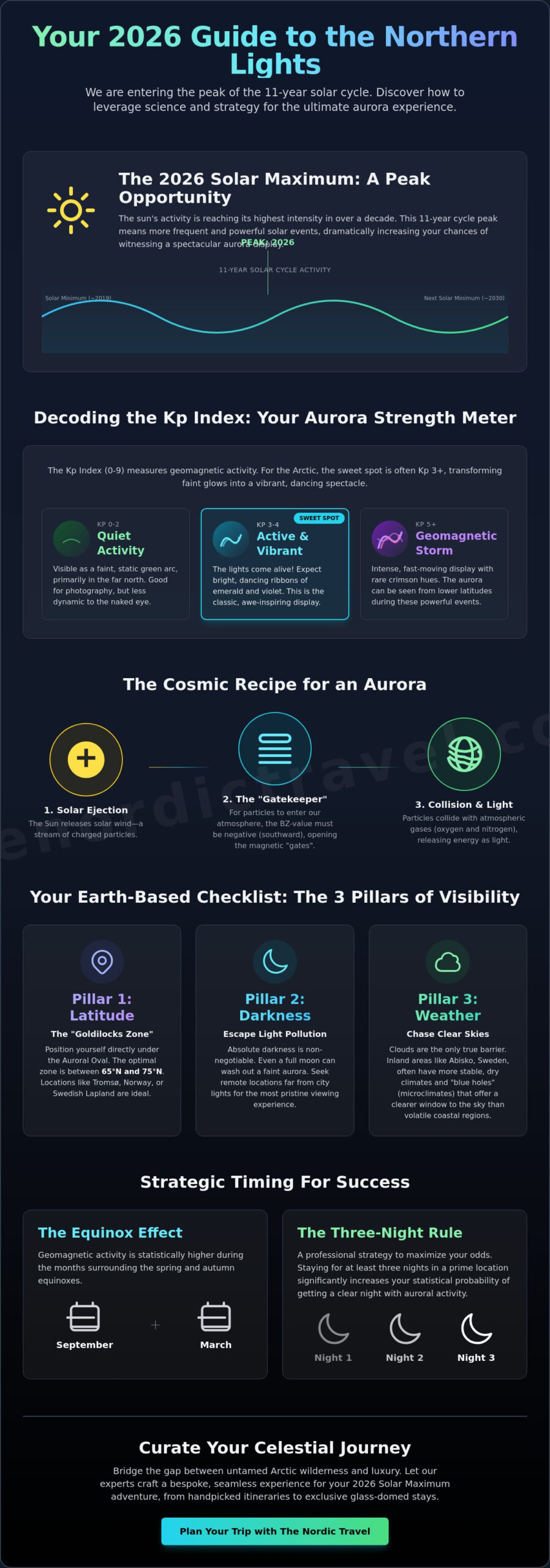
Understanding the Kp Index is the first step in answering what are the chances of seeing the northern lights on your journey. This scale, ranging from 0 to 9, quantifies geomagnetic activity over three-hour intervals. While a Kp 0 suggests a slumbering sky, a Kp 9 indicates a rare, intense geomagnetic storm that can push the lights far south. For those seeking the ethereal glow in the Arctic, a Kp 3 is often the coveted sweet spot. At this level, the lights transition from a faint, milky haze into the vibrant, dancing ribbons of emerald and violet that define the pristine Nordic night.
The phenomenon begins far beyond our atmosphere. Solar flares release sudden bursts of radiation, while Coronal Mass Ejections (CMEs) hurl massive clouds of plasma into space. These events, along with the constant solar wind, interact with Earth’s magnetic field. To truly grasp The Science Behind Auroras, one must look at the BZ-value. This magnetic gatekeeper determines if the solar particles can enter our atmosphere. When the BZ-value turns southward, or negative, the gates open. This allows the solar wind to pour into our magnetosphere and ignite the sky with light.
What Kp Level Do You Actually Need?
Your location dictates the Kp requirement. In the high latitudes of Tromsø or Lapland, a Kp 1 or 2 often suffices for a breathtaking display. Conversely, travellers in southern regions require a Kp 5 or higher to see the lights flickering on the horizon. The visual difference is striking. A Kp 2 typically appears as a static green arc, while a Kp 5 brings frantic movement and rare crimson hues. The Auroral Oval serves as the primary theatre for these sightings, a permanent ring of activity centered around the magnetic poles.
The Role of Solar Wind Speed
Speed and density are the silent architects of the display. A solar wind speed exceeding 400 km/s often triggers the most vivid colours. While a violent CME can create a spectacular, short-lived show, a steady, dense solar wind often provides a more reliable, curated experience for the patient observer. You don’t need an astrophysics degree to track this data. Simply look for high density, measured in protons per cubic centimeter, and a steady southward BZ-value on real-time monitoring apps. These metrics significantly influence what are the chances of seeing the northern lights during your bespoke winter retreat. It is the harmony of these variables that creates the magic.
- Kp 0-2: Quiet activity; visible mainly in the far north.
- Kp 3-4: Active sky; bright colours and movement common in the Arctic.
- Kp 5+: Geomagnetic storm; potential for sightings at lower latitudes.
The 2026 season promises heightened activity as we approach the solar maximum. This peak in the solar cycle means CMEs and solar flares occur more frequently. Your chances of witnessing a high-Kp event are statistically higher during this period. Planning your trip around these scientific cycles ensures your experience is as seamless and awe-inspiring as the landscape itself.
The Three Pillars of Visibility: Darkness, Weather, and Latitude
Even during the peak of the 2026 Solar Maximum, high solar activity is only one part of the equation. To truly understand what are the chances of seeing the northern lights, you must look toward the earth as much as the sun. The most spectacular solar storm becomes invisible if it is hidden behind a thick veil of clouds or washed out by the orange glow of city lights. Success in aurora hunting requires a perfect alignment of three specific pillars: the right latitude, absolute darkness, and a clear window into the atmosphere.
The first pillar is the “Goldilocks Zone” of latitude. This geographic sweet spot sits between 65°N and 75°N. While massive solar flares can occasionally push the aurora further south, staying within this Arctic band ensures you are standing directly under the Aurora Oval. In locations like Tromsø, Norway, or Swedish Lapland, the lights are a frequent presence even when solar activity is moderate. If you venture too far north of this zone, you may actually move inside the “donut hole” of the oval, where sightings become less frequent. Staying within this curated latitudinal range is the single most effective way to increase your odds.
Chasing Clear Skies: The Weather Factor
Clouds are the only true barrier between you and the celestial dance. Coastal regions in the Nordics often experience more volatile weather because the relatively warm Atlantic air meets the cold Arctic landmass, creating persistent cloud cover. In contrast, the inland tundra offers a more stable, dry climate. Places like Abisko in Sweden are famous for their “blue holes,” where local topography creates a microclimate that keeps the sky clear even when surrounding areas are overcast.
Flexibility is your greatest asset here. Professional mobile expeditions don’t just sit and wait; they use real-time satellite imagery and NOAA’s Aurora Forecast to find gaps in the cloud layer. Sometimes, driving just 30 kilometers inland can reveal a pristine, star-filled sky that was hidden at the coast. This active approach is why “chasing” the lights is far more successful than simply “watching” for them.
Escaping the Glow: The Impact of Light Pollution
Artificial light is a curtain that obscures the heavens. In a city center, you might see a faint green shimmer, but the experience lacks the ethereal, multi-dimensional quality found in the deep wilderness. To see the vibrant purples and the rapid, rhythmic pulsing of the ribbons, you need 100% darkness. Light pollution flattens the contrast of the sky, making it difficult for your eyes to perceive the subtle movements of the aurora.
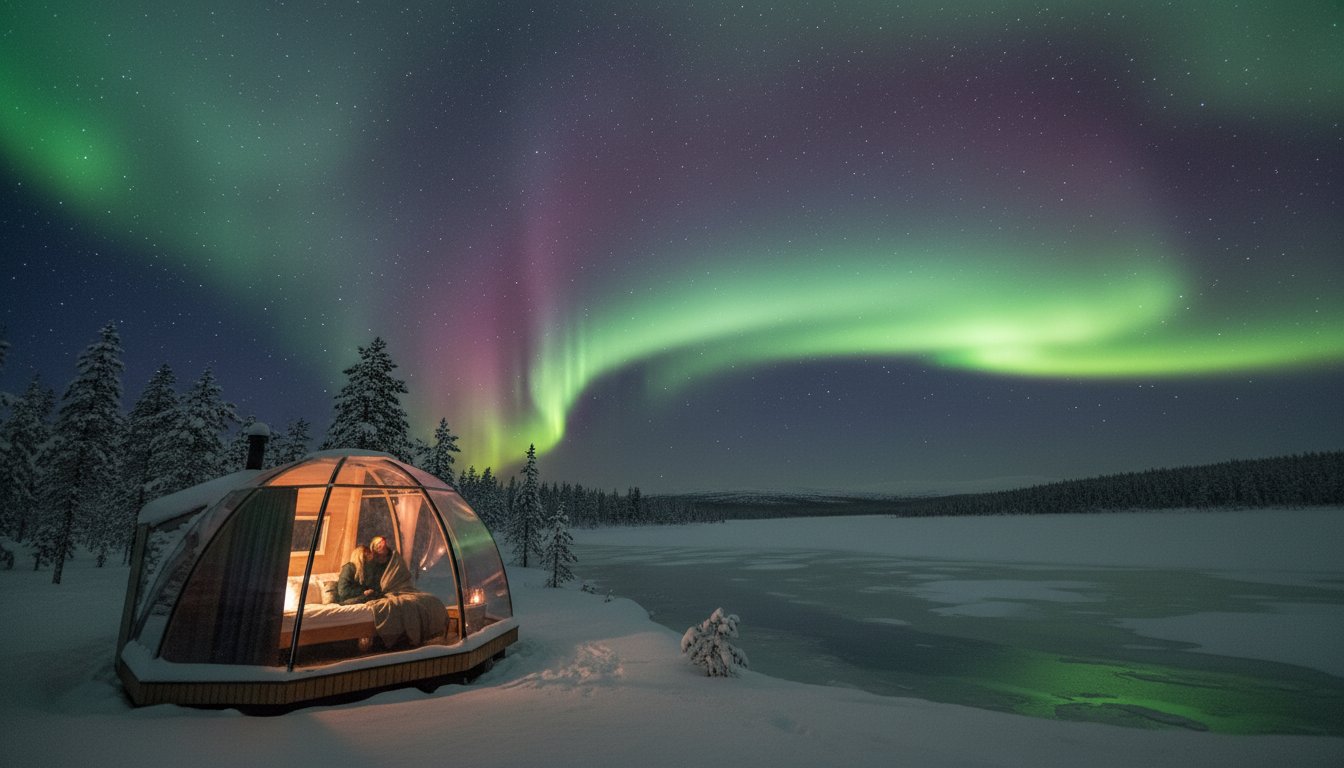
This is why we prioritize handpicked, remote accommodations. Staying in a secluded wilderness cabin or a private glass igloo allows your eyes to fully adjust to the dark, a process that takes about 20 minutes of total immersion. When you are miles away from the nearest streetlight, the stars feel close enough to touch, and the aurora takes on a brilliance that feels almost supernatural. You can find more details on these remote sanctuaries in our ultimate 2026 guide to the northern lights.
Ultimately, what are the chances of seeing the northern lights depends on your willingness to leave the beaten path. If you are ready to experience the quiet majesty of the Arctic night, a bespoke Arctic itinerary can ensure you are positioned in the right place at the right time, far from the distractions of the modern world.
Timing Your Journey: Seasonal Probabilities in 2026
Choosing the right moment to visit the Arctic is an art form. In 2026, the celestial odds shift heavily in your favor. This year marks the anticipated peak of Solar Cycle 25, a period known as the Solar Maximum. During this phase of the 11-year solar cycle, the sun’s magnetic field flips, resulting in a surge of sunspots and solar flares. For travelers asking what are the chances of seeing the northern lights, the answer is simple: they haven’t been this high since 2014. This peak creates an ethereal display that’s both more frequent and significantly more intense than in previous years.
The science behind these probabilities is rooted in the Russell-McPherron effect. During the spring and autumn equinoxes, the Earth’s magnetic field aligns more effectively with the solar wind. This alignment allows solar particles to penetrate our atmosphere more easily. According to data from the University of Alaska’s Aurora Forecast, these periods often yield the most reliable geomagnetic storms. You aren’t just looking for darkness; you’re looking for that perfect synergy between solar activity and planetary positioning.
The Best Months for a 2026 Expedition
- September to October: These months offer a rare, liquid beauty. Before the lakes freeze, the aurora reflects in the still, dark waters, doubling the visual impact. The weather remains mild, often hovering around 0 to 5 degrees Celsius, making long nights outdoors comfortable.
- November to February: This is the time of the “Polar Night.” While 24-hour darkness provides the maximum window for viewing, winter storms can occasionally obscure the sky. However, the pristine, snow-covered landscapes create a rugged, cinematic backdrop for the lights.
- March: Often considered the “Grand Finale” of the season. Statistics show March typically has more clear nights than mid-winter. Combined with the equinox effect, it offers a seamless blend of high solar activity and stable weather.
The Solar Maximum Advantage
The 2026 peak doesn’t just increase frequency; it expands the map. During a Solar Maximum, the auroral oval widens. This means the lights may become visible much further south than usual, though the heart of the Nordics remains the most reliable stage for a curated experience. 2026 will be the Golden Era for aurora photography, providing high-contrast displays that are easier to capture even for amateur enthusiasts. When you plan your journey, remember that what are the chances of seeing the northern lights depends as much on the sun’s rhythm as it does on the clear Arctic skies. We handpick locations where light pollution is non-existent, ensuring your encounter with the untamed sky is personal and profound.
Managing Expectations: The Myth of the Guaranteed Sighting
Nature doesn’t follow a human schedule. Even as we approach the solar maximum of 2026, a 100% guarantee of a display remains a marketing myth. When you ask what are the chances of seeing the northern lights, the honest answer involves a blend of solar physics and sheer luck. Statistics from long-term observations in regions like Tromsø suggest that staying for at least three nights increases your probability of a sighting to over 90%. This “Three-Night Rule” is the gold standard for travelers. It allows enough time for local weather systems to shift and for solar wind gusts to reach our atmosphere.
It’s vital to distinguish between the “camera-view” and the “human-eye” experience. Modern sensors capture light far more efficiently than our retinas. While a long-exposure photograph might show neon pinks and deep purples, your eyes may initially perceive a faint, ethereal mist. As the activity intensifies, these mists sharpen into the vibrant, dancing ribbons of legend. Adopting a “Nordic Mindset” means finding joy in the pristine silence of the Arctic night regardless of the sky’s performance. The untamed beauty of the landscape is a destination in itself.
Why “Aurora Hunting” is Better Than Waiting
Standing on a hotel balcony is a gamble; joining a bespoke guided chase is a strategy. Expert guides don’t just wait for the sky to clear. They use real-time satellite data and deep knowledge of local topography to find “blue holes” in the cloud cover. In places like Finnish Lapland, a guide might drive 150 kilometers to escape a coastal front. This seamless, professional coordination turns a potentially frustrating night into a curated adventure. You aren’t just waiting; you’re exploring the rugged wilderness with a purpose.
Understanding the Ethereal Quality
The moon is often misunderstood in the quest for the lights. You don’t need a pitch-black sky for a successful trip. A moon at 50% illumination can actually enhance the experience by lighting up the snow-capped peaks and frozen fjords, providing a stunning foreground for photographs. Staying comfortable is the final piece of the puzzle. Temperatures in the Arctic circle frequently dip below -25 degrees Celsius in February. High-quality thermal gear is essential so that you can focus on the shimmering horizon rather than the biting cold. When you understand these nuances, what are the chances of seeing the northern lights becomes a question of preparation rather than just hope.
Discover the magic of the Arctic with a tailor-made Northern Lights expedition designed by local experts.
Curating Your Celestial Journey with The Nordic Travel
Finding the Aurora Borealis is an art form that requires more than just looking up. While many travelers ask what are the chances of seeing the northern lights, the answer often depends on the precision of the itinerary. At The Nordic Travel, we believe your journey should be as ethereal as the sky itself. We specialize in handpicked expeditions that move beyond the ordinary, focusing on exclusive access to the most pristine viewing locations in the Arctic. Our bespoke itineraries place you in the heart of the wilderness, whether you are gliding across the snow in a private sledge or resting in a luxury glass dome designed for 360-degree views of the heavens.
Success in the North requires a delicate balance of timing and location. By prioritizing Scandinavia trip planning, we ensure your experience is seamless from the moment you arrive. We handle the logistics so you can focus on the magic. This is the moment to move from the dreaming phase into a true discovery of the North. Our 2026 expeditions are designed to maximize your time under the auroral oval, utilizing private transport and secluded lodges that keep you far from the light pollution of the crowds.
Why Professional Guidance Matters
The untamed northern landscapes are as unpredictable as they are beautiful. Local expertise is the bridge between a cold night in the dark and a life-changing celestial encounter. Our guides understand the microclimates of the rugged fjords and the inland tundras, knowing exactly when to move to find clear patches of sky. The Nordic Travel connects you with these respected resources, ensuring every night spent searching is backed by data and passion. We invite you to shed the stress of navigation and embrace a sense of child-like wonder as you wait for the first emerald glow to pierce the Arctic night.
Next Steps for Your 2026 Adventure
Preparation is the final ingredient for a successful aurora hunt. We recommend signing up for specialized aurora alerts and monitoring solar activity forecasts as your departure date approaches. The 2026 season promises to be one of the most active in a decade, making it the perfect time to explore our curated tour options. Take the time to review our tailor-made journeys that align with the peak of the solar cycle. Standing beneath the dancing lights is more than a holiday; it is a profound encounter with the raw power of the universe that will stay with you forever.
Begin Your Quest for the Arctic Glow
The heavens don’t offer guarantees, but 2026 presents a rare celestial window. As Solar Cycle 25 reaches its predicted peak through the coming year, the sun’s activity creates more frequent and intense auroral displays than we’ve seen in over a decade. You’ve discovered that what are the chances of seeing the northern lights depends on the delicate harmony of a high Kp index, pristine darkness, and clear Arctic skies. Since 2018, The Nordic Travel has mastered the art of positioning guests in these exact sweet spots. We combine deep scientific expertise with a commitment to sustainable, meaningful exploration of the untamed north. Our team understands that a truly bespoke journey requires more than just a map; it needs an intimate knowledge of the rugged landscapes where the lights dance most vividly. Don’t leave your dream to chance when you can rely on a seamless, handpicked experience designed by local experts. The Arctic is calling, and the stage is set for an unforgettable performance under the stars.
Explore our handpicked Nordic Tours for 2026
The ethereal beauty of the North awaits your arrival.
Frequently Asked Questions
What are the actual percentage chances of seeing the lights on a 5-day trip?
Statistically, you have a 90% chance of witnessing the aurora if you stay at least five nights within the Arctic Circle. While a single night is a gamble, a longer stay allows for weather shifts and solar fluctuations. This duration is the sweet spot for travelers asking what are the chances of seeing the northern lights during a curated winter escape.
Our data shows that guests who spend nearly a week in high-latitude regions like Tromsø or Finnish Lapland rarely go home disappointed. Patience is your greatest ally in the untamed north. By extending your stay, you ensure that a single cloudy evening doesn’t ruin your pursuit of this ethereal display.
Can I see the Northern Lights if the Kp index is only 1 or 2?
You can absolutely witness the celestial dance when the Kp index is as low as 1 or 2. In high-latitude destinations like Northern Norway or Iceland, even minimal solar activity creates a visible glow. While a Kp 5 storm is dramatic, a Kp 2 display often provides a delicate, pristine ribbon of green that feels deeply personal and exclusive.
Don’t let low numbers discourage you. Many of the most beautiful, curated experiences happen during these quiet moments. The lights might appear as a soft, shimmering veil rather than a roaring storm, but the magic remains just as potent in the silent, frozen wilderness.
Is it better to see the Northern Lights in Iceland, Norway, or Finland?
Each destination offers a bespoke experience tailored to different desires. Norway’s rugged fjords provide a dramatic backdrop for the lights, while Finland’s pristine forests offer the comfort of handpicked glass igloos. Iceland’s untamed volcanic landscapes create a cinematic stage, though its weather is more volatile than the stable microclimates found in Northern Sweden or Finnish Lapland.
If you seek a seamless blend of luxury and nature, Finland is often the preferred choice. For those who crave raw, coastal beauty, Norway’s archipelagoes are unmatched. We recommend choosing based on the daytime adventures you crave, as the lights themselves are equally magnificent across the entire auroral oval.
How far in advance can you accurately predict a Northern Lights display?
Scientists can predict general solar activity 27 days in advance based on the sun’s rotation, but precise accuracy only happens 30 to 60 minutes before the display. Real-time satellite data from the DSCOVR mission provides the most reliable window for immediate planning. We monitor these shifts to ensure your experience is seamless, catching the lights the moment the solar wind hits the atmosphere.
Long-term forecasts give us a glimpse into potential activity, but the aurora is a wild, untamed force. Short-term alerts are the only way to be certain of a sighting. Our local experts track these metrics constantly, so you don’t have to worry about the technical details during your journey.
Does a full moon make it impossible to see the aurora borealis?
A full moon won’t hide a strong aurora; it actually illuminates the rugged landscape for a more cinematic view. While a dark sky makes the colors pop, the moon’s light adds a silver glow to the snow and mountains. This creates a balanced, ethereal photograph that captures both the heavens and the pristine earth below.
Think of the moon as a natural spotlight for your Arctic surroundings. It doesn’t wash out the lights unless the display is exceptionally faint. Many photographers actually prefer the moon’s presence because it brings a sense of scale and depth to the untamed northern horizon.
What happens if it is cloudy during my entire Northern Lights trip?
If clouds cover your location, the best strategy is to travel inland where the air is drier and clearer. In regions like the Lyngen Alps, coastal clouds often break just a few miles away. Our curated tours use local meteorological expertise to navigate these microclimates, ensuring your chances of seeing the northern lights remain high even during unsettled weather.
Flexibility is the key to success in the Arctic. Chasing the lights often means driving through different weather systems to find a pocket of pristine sky. It’s a thrilling part of the adventure that turns a stationary wait into a purposeful, guided exploration of the north.
Is 2026 really the best year to see the Northern Lights?
2026 is a peak year for solar activity as we remain within the Solar Maximum of Cycle 25. This period brings the most frequent and intense displays seen in over a decade. It’s a rare opportunity to witness the untamed power of the sun at its most active, making it the most auspicious time for an exclusive Arctic journey.
NASA and NOAA data confirm that solar cycles last roughly 11 years, and we’re currently approaching the height of the current cycle. This means more vibrant colors and more frequent sightings. If you’ve been waiting for the perfect moment to book your bespoke trip, 2026 offers the highest probability of success.
Do I need a professional camera to see the colours of the aurora?
Modern smartphones can capture the aurora, but your eyes will perceive the movement and scale in a way no lens can. High-end cameras use long exposures to pull out deep reds and purples that are often invisible to us. Still, the most profound part of the journey is the raw, ethereal connection you feel when the lights dance across the pristine night sky.
Don’t spend your whole night behind a tripod. While a professional setup helps capture the neon greens and violets, the memory of the light’s silent movement is what truly stays with you. It’s about that first moment of child-like wonder when the sky begins to shimmer above the silent, frozen world.